Vinland Saga Manga: The Complete Guide
Is Vinland Saga Manga the Greatest Manga Ever Written?
Most manga readers hit a wall — they finish a series and feel empty, wondering if anything else could hit that hard. The Vinland Saga manga solves that problem completely. Makoto Yukimura built a story where violence has consequences, revenge has a cost, and a boy who loses everything finds a reason to live. Start here, and you will not put it down until the last page.
Written by a Manga Enthusiast & Cultural Analyst | Reviewed with sources from Kodansha, MyAnimeList, and Manga Plus.
QUICK REFERENCE TABLE
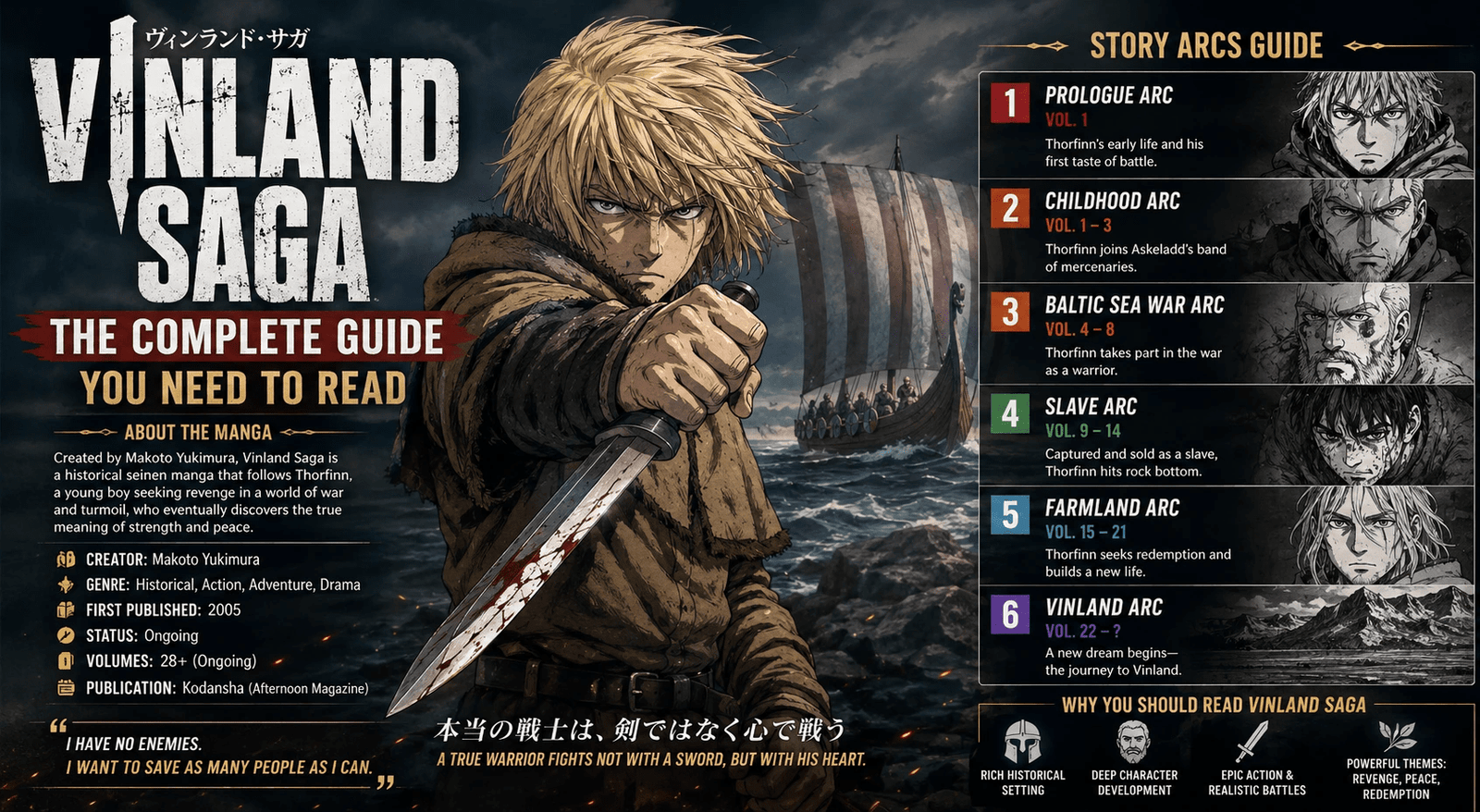
Manga Title — Vinland Saga (ヴィンランド・サガ) Author / Artist — Makoto Yukimura Publisher (Japan) — Kodansha, Monthly Afternoon English Publisher — Kodansha USA Serialization Start — April 2005 Current Status — Ongoing (as of mid-2025) Volumes Published — 27+ volumes (English) Genre — Seinen, Historical, Action, Drama Setting — Viking Age Europe, 10th–11th century Anime Adaptation — WIT Studio (S1), MAPPA (S2 & S3) Awards — Kodansha Manga Award; Cultural Agency Media Arts Festival Award Reading Direction — Right to left (Japanese format) Age Rating — Mature (17+) Where to Read — Manga Plus (free), Kodansha, physical volumes
What Is the Vinland Saga Manga About?
The Vinland Saga manga follows Thorfinn Karlsefni, the son of a legendary Norse warrior named Thors. After watching his father die at the hands of the mercenary Askeladd, young Thorfinn dedicates his entire childhood to getting revenge — fighting under the very man who killed his father, earning duel after duel, and losing every single one.
What makes the Vinland Saga manga different from other action stories is that it does not glorify the cycle Thorfinn is trapped in. It shows the damage it causes — to his body, his mind, and everyone around him. The manga is a war story, a revenge story, and ultimately a peace story, all layered on top of authentic Viking Age history.
The second half of the story, known among fans as the Farmland Arc, completely shifts the genre. Thorfinn wakes up as a slave with nothing left — no sword, no goal, no identity. From that point forward, the Vinland Saga manga becomes something rarer: a meditation on what it means to choose a different path.
Why Did Makoto Yukimura Create This Story?
Makoto Yukimura has spoken openly about his inspiration in multiple interviews. He wanted to write about violence without making it look appealing. He grew up reading manga where battles were exciting and victory felt triumphant, and he wanted to challenge that narrative directly
Yukimura based the Vinland Saga manga on real Norse sagas — particularly the Saga of the Greenlanders and the Saga of Erik the Red — ancient Icelandic texts that document the first European contacts with North America. The historical Thorfinn Karlsefni was a real explorer, and Yukimura used that foundation to ask a powerful question: what if the man who discovered Vinland was running away from a cycle of violence?
Historical Note: Vinland is the name Norse explorers gave to a coastal region in North America — believed to be modern-day Newfoundland, Canada — approximately 500 years before Columbus arrived.
How Are the Story Arcs Structured?
The Vinland Saga manga divides naturally into distinct arcs, each with a different emotional core. New readers should know what they are walking into before they begin, because the tone shifts significantly between arcs.
War Arc (Prologue) — Introduces Thors, young Thorfinn, and Askeladd. Brutal, fast, and emotionally devastating.
Revenge Arc (Chapters 1–54) — Thorfinn fights through mercenary life in England and Denmark, chasing the duel he cannot win.
Farmland Arc (Chapters 55–116) — Thorfinn becomes a slave. The manga slows down and asks harder questions. Many readers call this the best arc.
Eastern Expedition Arc — Thorfinn takes his first real steps toward Vinland — with allies, grief, and impossible odds.
Vinland Arc (Ongoing) — The dream becomes reality. Thorfinn faces the true cost of building something peaceful.
Who Are the Key Characters in the Vinland Saga Manga?
Thorfinn Karlsefni
The protagonist of the Vinland Saga manga. He starts as a gifted child turned hollow mercenary, driven entirely by hatred. His transformation across the story is one of the most complete character arcs in manga history. By the later chapters, Thorfinn is nearly unrecognizable from the boy readers meet in volume one — and that is the whole point.
Askeladd
Arguably the most complex character in the Vinland Saga manga. Askeladd is cunning, brutal, and surprisingly principled. He serves as a dark mentor, a villain, and — in ways that only become clear later — a strange kind of protector. His arc ends in one of the most shocking and emotionally earned moments in the series.
Thors
Thorfinn’s father and the story’s moral compass. Thors walked away from war and chose a farmer’s life. The Vinland Saga manga returns to his philosophy again and again: a true warrior needs no sword. His influence shapes the entire story even though his time on the page is short.
Einar
Thorfinn’s companion in the Farmland Arc and the emotional heart of the second half. Einar is warm where Thorfinn is cold, angry where Thorfinn has gone numb. Their friendship gives the manga its humanity during its most quietly powerful stretch.
Canute
A historical figure — the real King Canute the Great of England, Denmark, and Norway — reimagined as a sheltered prince who becomes one of the most morally complex rulers in the Vinland Saga manga. His arc asks what a person gives up when they choose power over idealism.
What Makes the Art Style So Distinctive?
Makoto Yukimura’s art in the Vinland Saga manga is precise and restrained. He uses detailed panel compositions to convey weight and exhaustion rather than speed and flair. Battle scenes feel heavy — you feel the impact of every blow instead of admiring the choreography.
One of Yukimura’s most praised techniques is his facial expression work. He draws silence better than dialogue in many scenes. A single panel of Thorfinn’s blank face communicates more than a full page of exposition could.
Realistic proportions and anatomy — compared to most seinen titles Minimal screentone use — heavy reliance on clean linework Expansive landscape panels — that give the Viking world genuine scale Historical costume and ship design — researched from authentic Norse sources Color pages in volume covers — showing Yukimura’s full artistic range
How Historically Accurate Is the Vinland Saga Manga?
Yukimura takes historical accuracy seriously — more than most historical manga authors. Major figures like King Canute, Thorkell the Tall, and Ragnar are based on real people documented in Norse sagas and Anglo-Saxon chronicles. The political conflicts between Denmark and England during the early 11th century form the actual backbone of the Revenge Arc.
The Vinland Saga manga does take creative liberties. Thorfinn’s father Thors is fictional, as is much of the personal drama surrounding the characters. But the larger world — Viking raids on English soil, Danish control of parts of England, and Norse settlements in Iceland and Greenland — align closely with documented history.
“Yukimura once described his goal as making readers feel the Viking Age rather than simply depicting it — the cold, the hunger, the moral confusion of a society built on conquest.”
Where Can You Read the Vinland Saga Manga?
Reading the Vinland Saga manga is straightforward if you know where to look. Kodansha offers legal options across multiple platforms:
- Manga Plus by Shueisha — Free to read first and latest chapters legally
- Kodansha’s official website — Digital volumes for purchase in English
- Amazon Kindle & ComiXology — Digital English volumes, all 27+ available
- Bookshops and comic stores — Physical volumes in English, hardcover and standard
- Local libraries — Many carry Kodansha titles; check your library’s digital catalog
If you want to own the Vinland Saga manga physically, the Kodansha hardcover omnibus editions are exceptional. They include higher-quality paper, color pages, and bonus content not available in the standard paperback volumes.
Must You Browse the Manga or Watch the Anime First?
Every person who discovers Vinland Saga faces this exact decision. Neither choice is wrong, but they lead to two very different first experiences.
The anime brings the world to life in ways the page simply cannot match. WIT Studio’s work on Season 1 gave the Viking Age a weight and texture through sound and motion that stays with you. MAPPA continued that standard in Season 2, turning the quieter Farmland Arc into something almost meditative on screen. If moving images draw you into stories faster than static panels do, start with the anime — it is one of the strongest adaptations of any manga in the last decade.
The Vinland Saga manga rewards readers who want the full picture. Yukimura’s internal storytelling — the thoughts Thorfinn never says out loud, the small moments between major events, the world-building that gets trimmed for runtime — all of it lives in the manga and nowhere else. Readers who went through the anime first often say the manga felt like reading a director’s cut. Everything hits harder when you already know where it ends up.
The most common path among long-term fans is to watch the anime first, then read the manga from the beginning. Going back through familiar events with the full context of the manga’s depth turns the whole story into something richer than either version delivers alone.
If you only have time for one — choose based on how you prefer to experience stories. Both are worth your time. Most readers eventually do both anyway.
What Awards and Recognition Has It Received?
The Vinland Saga manga has earned serious critical recognition over its twenty-year run. It is not just popular — it is respected by industry professionals and cultural institutions.
Kodansha Manga Award (General Category) — one of Japan’s most prestigious manga prizes Agency for Cultural Affairs Media Arts Festival Award — recognition from Japan’s government cultural body Consistently ranked top 10 on MyAnimeList, Anime-Planet, and AniList — by hundreds of thousands of readers Listed in multiple essential seinen manga guides — by major publications covering Japanese media Crunchyroll Anime Awards recognition — for both Season 1 and Season 2 of the anime adaptation
How Does Vinland Saga Manga Handle Heavy Themes?
The Vinland Saga manga does not look away from its themes. It handles war, slavery, grief, trauma, and the meaning of manhood with a directness that earns its mature rating. Violence is depicted with consequences — it is never clean, exciting, or cost-free.
The slavery arc draws on serious historical realities. Viking-Age slave trading — known as the thrall system — was widespread across Northern Europe. Yukimura depicts this honestly, without making it exploitation for shock value. The Farmland Arc uses Thorfinn’s enslavement to examine what it means to be stripped of identity, agency, and worth — and what it takes to rebuild.
Readers dealing with themes of trauma, loss, or rebuilding a sense of purpose will find the Vinland Saga manga resonates on a personal level that goes well beyond entertainment. Many fans describe specific arcs as genuinely changing how they think about anger, revenge, and peace.
Is the Vinland Saga Manga Still Worth Starting Today?
Yes — completely. The Vinland Saga manga is one of those rare long-running series where the quality does not drop as it continues. If anything, the later arcs are more ambitious than the early ones. The storytelling grows in confidence, the themes deepen, and Thorfinn’s journey feels even more earned with every new chapter.
Starting today means you have 27+ volumes ready to read without waiting. The Vinland Arc, currently ongoing, is drawing the story toward its final destination with the deliberate, emotional pacing the series has always delivered. For new readers, there has never been a better time to start.
Frequently Asked Questions About Vinland Saga Manga
Q: How many volumes does the Vinland Saga manga have?
A: As of mid-2025, the Vinland Saga manga has over 27 volumes published in English by Kodansha USA. The series is still ongoing in Japan, with new chapters appearing in Monthly Afternoon. The Japanese volume count is slightly ahead of the English release schedule.
Q: Is the Vinland Saga manga finished or still ongoing?
A: The Vinland Saga manga is still ongoing. Makoto Yukimura is currently serializing the Vinland Arc, which is expected to be the final arc of the series. No official end date has been announced, but the story is clearly moving toward its conclusion.
Q: Where does the anime leave off compared to the manga?
A: Season 1 covers the Revenge Arc (chapters 1–54 roughly). Season 2 adapts the Farmland Arc. Season 3 is in production and will cover the Eastern Expedition Arc. Readers who want to get ahead of the anime can pick up the manga from the Eastern Expedition Arc onward.
Q: Is the Vinland Saga manga appropriate for teenagers?
A: The Vinland Saga manga carries a mature rating (17+). It contains graphic battle violence, depictions of slavery, and mature psychological themes. Mature teenagers who read seinen manga regularly will handle it, but parents should preview it before recommending it to younger readers.
Q: What chapter does the Farmland Arc start?
A: The Farmland Arc begins around chapter 55. Volume 9 in the Kodansha English release is a good reference point — that is approximately where the second major phase of the story begins.
Q: Is Vinland Saga manga better than the anime?
A: Both versions are exceptional, but the Vinland Saga manga goes deeper. Internal character thoughts, extended scenes, and additional world-building make the manga the more complete experience. The anime has superior music and animation. Most dedicated fans end up doing both — and say reading the manga after watching the anime makes it even better.
The Journey to Vinland Starts With One Chapter
The Vinland Saga manga is not a perfect escape — it is a mirror. It asks you to sit with violence, regret, and the desire for something better. It earns every emotional moment across thousands of pages because Yukimura never takes shortcuts. If you have been looking for a manga that treats you like an adult reader while still giving you genuine hope at the end — this is it.
Pick up volume one today. Start with the prologue. By the time you reach the end of the first arc, you will already know this is something special. Share this guide with anyone who asks you where to start with Vinland Saga manga.