What Makes an Anime Girl Character
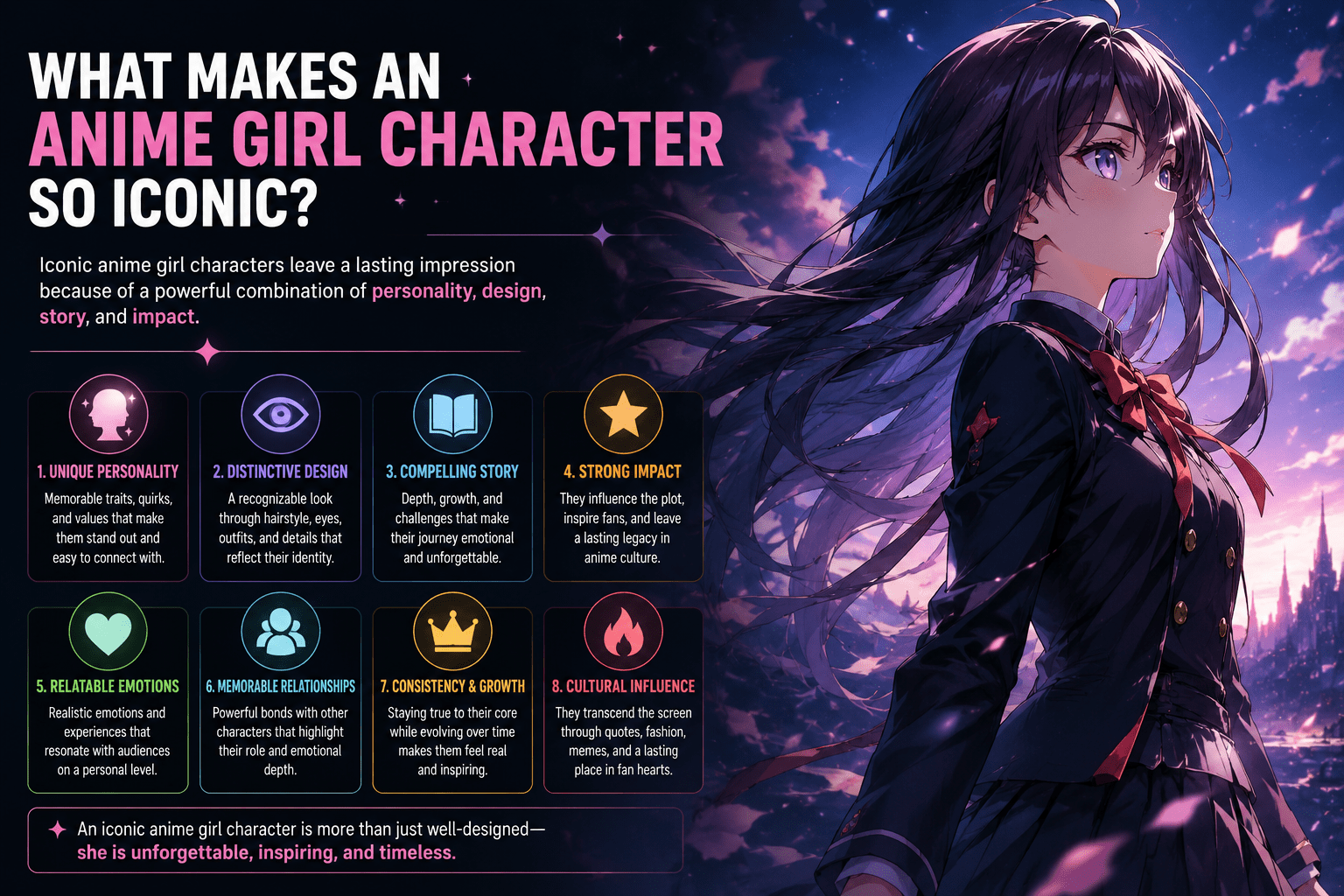
What Makes an Anime Girl Character So Instantly Recognizable?
You’ve seen her before — big bright eyes, expressive hair, and a personality that pulls you into the story within seconds. The anime girl is one of the most studied and celebrated designs in all of visual storytelling. Yet most people don’t know why she works so well. This book explains why she continues to influence entertainment globally and what makes her design, emotion, and cultural impact so potent.
What Exactly Is an Anime Girl?
An anime girl refers to a female character depicted in the Japanese animation style, commonly called anime. These characters appear across films, television series, manga adaptations, and video games. What separates them from Western animation is the visual philosophy behind their creation — every element, from eye shape to hairstyle, carries meaning.
The term covers a wide range — from fierce warriors to quiet scholars, comedic leads to tragic heroines. Each anime girl is a product of careful artistic and narrative decisions.
The History Behind Female Anime Characters
Female characters in anime trace back to the foundational works of Osamu Tezuka, often called the “father of manga.” His early 1950s work introduced expressive, large-eyed characters that would become the visual language of the medium.
Anime heroines were no longer on the outside of storytelling during the 1970s and 1980s thanks to programs like Candy Candy and Sailor MoonThese characters had goals, flaws, and growth — not just pretty faces.
Today, publications like Anime News Network and studies from the Japan Foundation document how female anime characters have expanded into every genre imaginable, from sports dramas to psychological thrillers
Why Anime Eyes Are the Most Expressive Feature
Anime eyes are not realistic — and that is completely intentional. Artists use oversized irises, bright highlights, and layered color to communicate emotion at a glance. A fearful character might have eyes that tremble with thin, shaking pupils. A confident anime girl carries wide, sharp eyes with a bold outline.
This technique is rooted in the theatrical tradition of kabuki theater, where exaggerated expressions communicated emotion to audiences far from the stage. Anime artists carried this principle into a drawn format.
Here is what the different eye styles typically signal:
- Large, round eyes — innocence, youth, openness
- Narrow, sharp eyes — cunning, experience, or authority
- Half-lidded eyes — confidence, boredom, or a calm personality
- Teary, trembling eyes — vulnerability, emotional depth
- Gleaming, sparkled eyes — excitement, passion, or falling in love
The highlight dot placed inside the iris — called a catchlight — gives the character a sense of life and soul. Without it, even a well-drawn anime girl can feel cold or distant.
Common Archetypes You’ll Recognize Immediately
Anime characters, particularly female ones, are often built around recognizable personality archetypes. These are not lazy shortcuts — they are storytelling tools that writers build on, break, or subvert to create depth.
The Tsundere Cold and sharp on the outside, warm underneath. Characters like Asuka Langley from Neon Genesis Evangelion define this type. The push-and-pull tension between her harsh words and her real feelings drives entire arcs.
The Kuudere Quiet, emotionless on the surface, but deeply feeling inside. Rei Ayanami, also from Evangelion, became one of the most analyzed anime girls in history because her stillness hid enormous emotional complexity.
The Genki Girl Bright, loud, full of energy. She motivates the group and rarely slows down. Characters like Usagi Tsukino from Sailor Moon fall here — optimism as a superpower.
The Yandere Devoted to the point of obsession. Yuno Gasai from Future Diary made this archetype famous worldwide. The archetype explores how love, when distorted, becomes something dangerous.
The Dandere Shy, quiet, and slow to open up. These characters reward the audience’s patience with genuine emotional payoff once they finally express themselves.
Understanding these archetypes helps viewers predict behavior — and appreciate when a great anime girl breaks the pattern.
What Makes an Anime Girl Design Memorable?
Strong character design is never accidental. A skilled character artist considers several visual layers before finalizing the look of an anime girl:
Hair Hair is the single most powerful visual identifier in anime. Long silver hair suggests mystery or elegance. Short, messy hair reads as energetic or tomboyish. Two-tone or unnatural hair colors (pink, blue, white) signal a character outside normal social categories — powerful, magical, or otherworldly.
Outfit Clothing communicates role and personality immediately. A school uniform creates instant relatability. A military uniform signals discipline and authority. A flowing robe or battle armor places the character in a different world entirely.
Color Palette: Primary, secondary, and accent colors are the three colors that character designers frequently employ.. These colors then repeat across different outfits, settings, and emotional scenes to tie the character’s visual identity together.
Silhouette A well-designed anime girl should be recognizable from her shape alone, even in full shadow. This is a professional test designers use to check whether their work is strong enough.
The Role of Voice in Bringing Her to Life
Voice acting — called seiyuu work in Japan — transforms a drawn anime girl into a living presence. The tone, pacing, and emotional range of a voice actor shapes how audiences interpret every scene.
Veteran voice actress Megumi Hayashibara has voiced iconic characters like Rei Ayanami and Lina Inverse. Her ability to shift between emotional ranges without losing consistency is considered a benchmark in the industry.
Many anime girls now have dedicated fan followings built almost entirely around their voice — the sound becomes as iconic as the design.
How Anime Girls Influence Fashion and Visual Culture
The influence of the anime girl on global fashion is measurable and documented. The Harajuku fashion movement in Tokyo draws heavily from anime aesthetics — pastel colors, exaggerated accessories, layered skirts, and dramatic eye makeup.
Internationally, cosplay communities recreate anime girl looks with remarkable precision. Events like Comiket in Japan and Anime Expo in Los Angeles attract hundreds of thousands of attendees who treat character recreation as a serious art form.
Street fashion brands in South Korea, Thailand, and increasingly in Europe now release collections directly inspired by anime character design. The anime girl has moved from screen to sidewalk.
Famous Anime Girl Characters Who Changed the Industry
Some characters do not just entertain — they shift the direction of an entire medium.
Sailor Moon (Usagi Tsukino) Created by Naoko Takeuchi, Sailor Moon proved that an anime girl could headline an action series without being made secondary to male characters. She carries hope, cries when it hurts, and still wins.
Asuka Langley Soryu Her psychological depth in Neon Genesis Evangelion changed what audiences expected from female anime characters. She was flawed, brilliant, broken, and real in ways animation had rarely attempted.
Mikasa Ackerman From Attack on Titan, Mikasa redefined what physical strength looked like for an anime girl without removing emotional complexity. Her relationship with Eren is one of the most debated in modern anime.
Nezuko Kamado From Demon Slayer, Nezuko became a global icon almost instantly. Her design — compact, protective, silent for much of the series — works because it inverts expectations. She communicates through action, not words.
Violet Evergarden Perhaps the most emotionally sophisticated anime girl in recent years. Her journey through grief, identity, and purpose moved audiences worldwide and demonstrated that animation can handle the deepest human questions.
Anime Girl vs. Western Female Characters: Key Differences
This comparison is not about which is better — it is about understanding what makes the anime girl distinct as a design tradition.
| Feature | Anime Girl | Western Animation Female |
| Eye size | Exaggerated, expressive | More proportional |
| Hair | Often unnatural color, elaborate | Closer to realistic |
| Emotional display | Highly visual, symbolic | More subtle or verbal |
| Body language | Coded by archetype | More naturalistic |
| Background depth | Often tied to cultural symbolism | More genre-driven |
| Character arcs | Often internal/emotional | Often external/action |
Neither approach is wrong. They serve different storytelling goals.
How to Draw an Anime Girl: Core Principles
For artists starting out, the anime girl presents a structured entry point into character design. These are the foundational steps:
- Start with a circle for the head — anime heads are rounder than realistic proportions
- Place the eyes low — lower than the midpoint of the face, which increases the youth and openness of the character
- Build anime eyes in layers — outer line, inner iris, pupil, highlight, shadow, catchlight
- Keep the nose minimal — a small line or shadow, rarely a full nose shape
- Use the mouth for emotion — a small, simple mouth carries enormous expressive range in anime
- Design the hair in sections — front bangs, side strands, and back volume as separate shapes
Books like How to Draw Manga published by Graphic-sha and tutorials from professional artists on platforms like Clip Studio Paint’s official blog offer structured learning paths.
What Parents and Educators Should Know About Anime Girls in Media
Anime spans every age group and rating category. Not all content featuring an anime girl is appropriate for children — and parents benefit from understanding this before dismissing or blindly approving it.
- All ages: My Neighbor Totoro, Kiki’s Delivery Service, A Silent Voice
- Teen appropriate: Sailor Moon, My Hero Academia, Violet Evergarden
- Mature themes: Neon Genesis Evangelion, Puella Magi Madoka Magica, Attack on Titan
Organizations like Common Sense Media provide content ratings and parent guides for popular anime series. Treating anime as a genre, rather than an age category, helps families make informed choices.
The Global Rise of the Anime Girl in Streaming and Gaming
Netflix, Crunchyroll, and Funimation have brought anime to over 100 countries. With that reach, the anime girl has become a globally recognized cultural figure.
In gaming, characters like 2B from NieR: Automata (developed by PlatinumGames) and Aloy from Horizon (though Western-made, influenced by anime aesthetics) show how the visual language crosses platforms.
Mobile games like Genshin Impact and Blue Archive have built entire economies around anime girl character design — with millions of players worldwide investing time and money into collecting, customizing, and storytelling around these characters.
According to Statista, the global anime market reached over $25 billion in 2022 and continues to grow. Female characters are central to that value.
FAQs About Anime Girl Characters
Q: What defines an anime girl compared to other animated female characters?
An anime girl is designed within the Japanese animation visual tradition — characterized by large expressive eyes, stylized hair, and emotionally coded design choices. The design communicates personality and emotional state visually, often using symbolic shorthand that Western animation does not typically use.
Q: Why are anime eyes drawn so large?
Anime eyes are large to maximize emotional expression. The face is a small canvas — by enlarging the eyes, artists give themselves more room to show fear, joy, love, and grief in a single frame. The technique traces back to early manga artists who studied both Disney animation and kabuki theater.
Q: Are all anime girl characters the same archetype?
No. The medium covers dozens of distinct character types — from silent and introspective to loud and impulsive. While archetypes like tsundere or kuudere exist as shorthand, the strongest anime girl characters subvert or evolve beyond their starting type.
Q: What anime girl characters are considered the most influential?
Sailor Moon, Rei Ayanami, Asuka Langley, Mikasa Ackerman, Violet Evergarden, and Nezuko Kamado are widely cited by fans, critics, and industry professionals as characters who shaped the direction of anime storytelling.
Q: Can anime girls have realistic personalities?
Absolutely. The visual style is exaggerated, but the best anime girl characters carry psychologically complex, internally consistent personalities. Shows like Neon Genesis Evangelion and A Silent Voice are studied in media courses for their depth of character work.
Q: Is the anime girl design style used outside Japan?
Yes. The aesthetic now appears in South Korean webtoons, Chinese animation (donghua), Western indie games, and global fashion. The visual language has traveled far beyond its origin and continues to evolve as artists worldwide adopt and adapt it
The Anime Girl Is More Than a Drawing
She carries culture, history, craft, and emotion. The anime girl endures because she is not a single character — she is a design philosophy built to communicate humanity through stylized art. Whether you are a longtime fan, a curious newcomer, or an artist trying to understand what makes her work, the answer is always the same: intention.
Every line, color, and expression exists for a reason. That care is what audiences feel, even when they cannot name it.
If you want to go deeper — start watching, start drawing, or start studying the artists who built this tradition. The community is open, the resources are available, and the characters are waiting.
Sources Referenced:
- Anime News Network — animenewsnetwork.com
- Japan Foundation cultural research — jpf.go.jp
- Common Sense Media anime guides — commonsensemedia.org
- Statista anime market data — statista.com
- Clip Studio Paint artist tutorials — clipstudio.net