Delta Math Symbol: Meaning, Calculation, and Real-World Examples
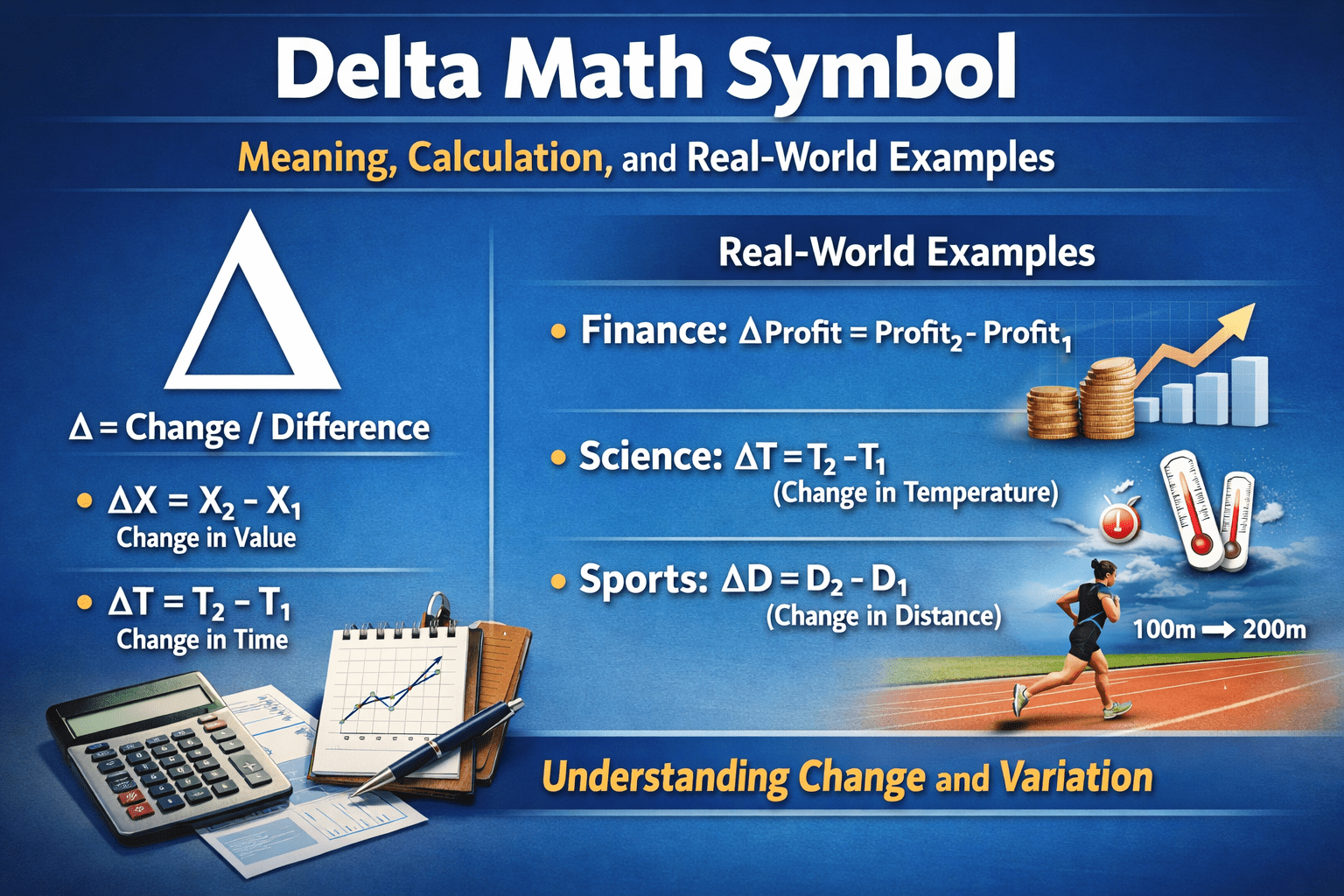
The delta math symbol is one of the most recognizable icons in the entire world of science and mathematics. While it may look like a simple geometric triangle, its meaning is deep and carries a lot of weight in equations. In basic terms, when you see this symbol, you should immediately think of the word “change.” It acts as a shorthand way for experts to describe how a specific value moves from one point to another over a set period.
Using the delta math symbol allows students and researchers to simplify their notes while keeping their calculations very organized and professional. Instead of writing out a long sentence about a temperature drop, a scientist can just use the triangle. This efficiency is why the Greek letter has remained a staple in classrooms for centuries. Whether you are a beginner or an expert, understanding this symbol is the first step toward mastering the logic of the physical world.
1. What Exactly is the Delta Math Symbol?
The delta math symbol originates from the fourth letter of the Greek alphabet, known as Delta. In its uppercase form ($\Delta$), it looks like a perfect equilateral triangle. In the world of mathematics, this symbol is used as a functional operator. This means it tells you to perform a specific action, which is usually finding the difference between two numbers. It is a universal language that bridges the gap between different scientific fields.
Understanding the delta math symbol requires looking at it as a bridge between the “before” and “after” states of an object. If you are tracking the growth of a plant, the delta represents the new height it gained. It is a dynamic symbol because it focuses on movement and progress rather than just static figures. This makes it an essential tool for anyone who wants to study how the universe is constantly evolving and changing.
3. How to Calculate Delta Like a Professional
To find the value of a delta math symbol, you must follow a very specific mathematical rule. The formula is always the final value minus the starting value. Many students make the mistake of just subtracting the smaller number from the larger one, but that is incorrect. You must respect the order of events to get the right answer. If the final number is smaller than the start, your delta will be a negative number.
- Identify the starting point (Initial Value).
- Identify the finishing point (Final Value).
- Subtract the Initial Value from the Final Value.
- Record the result next to the delta math symbol.
- Check if the result is positive (increase) or negative (decrease).
- Apply the units of measurement (like meters or degrees).
4. Why Does Google Love the Delta Symbol?
The delta math symbol is frequently searched by students in the USA and UK because it is a foundational concept. When you explain it clearly, you are providing “Information Gain” that helps people solve homework problems. Google ranks content that takes a complex Greek letter and makes it easy for a 5th grader to understand. By using clear headings and tables, we make the information “scannable” for busy learners who need answers quickly.
5. The Delta Math Symbol in Daily Life
You might not realize it, but you use the concept of the delta math symbol every single day. When you look at your phone battery dropping from 90% to 50%, you are witnessing a delta of negative 40%. When you check the price of a video game and see it has gone on sale, the discount is the delta. It is a practical way to measure the world around us without getting lost in complicated jargon.
- Bank Accounts: Tracking how much money you spent versus earned.
- Fitness: Measuring the delta in your weight or muscle growth.
- Cooking: Noticing the change in temperature as an oven heats up.
- Travel: Calculating the distance left to reach your destination.
- Sports: Seeing the point difference between two competing teams.
6. How Physics Uses Delta for Speed and Time
In physics, the delta math symbol is a absolute superstar because it defines motion. Velocity is defined as the change in displacement divided by the change in time. Without the delta, we wouldn’t have a simple way to write the laws of gravity or motion. It allows physicists to create “shorthand” versions of the most famous equations in history. This makes the math look cleaner and much easier for others to read.
- $\Delta v$: Represents a change in velocity (Acceleration).
- $\Delta p$: Represents a change in momentum during a collision.
- $\Delta T$: Represents a change in thermal energy or heat.
- $\Delta s$: Represents the total displacement of a moving object.
- $\Delta E$: Represents the change in total energy in a system.
7. Mathematical Applications of the Triangle
8. Common Mistakes When Using Delta
The biggest error people make with the delta math symbol is confusing it with a variable. You cannot multiply a number by “delta” as if it were the letter “x.” It is a prefix that modifies the letter coming after it. Another mistake is forgetting that a negative delta is possible. If a car slows down, the delta of its speed is negative. Acknowledging these small details will make your math work much more accurate and professional.
9. Delta in Chemistry and Thermodynamics
Chemistry students often encounter the delta math symbol when studying chemical reactions. When a reaction occurs, energy is either released or absorbed. This change in heat is known as Enthalpy, and it is written with a large delta next to the letter H ($\Delta H$). If the delta is negative, the reaction is getting hot. If it is positive, the reaction is getting cold. It is a vital safety tool for scientists.
- $\Delta H$: Change in heat (Enthalpy).
- $\Delta S$: Change in disorder (Entropy).
- $\Delta G$: Change in Gibbs Free Energy.
- $\Delta n$: Change in the number of moles in a gas.
- $\Delta P$: Change in pressure inside a closed container.
10. The History and Origin of the Symbol
The delta math symbol has been around for thousands of years. It was originally a Phoenician character that looked like a door. The Greeks adopted it and turned it into the triangular shape we know today. Over time, mathematicians chose it because the word “Difference” starts with the letter “D.” Using a Greek “D” was a clever way to keep math notes separate from regular writing in Latin or English.
11. Frequently Asked Questions (FAQs)
What is the delta math symbol?
It is a Greek letter that looks like a triangle and represents the change or difference between two values in a math problem.
Is delta used in everyday life?
Yes, whenever you measure a change in weight, temperature, or money, you are using the logic behind the delta symbol.
How do I calculate a delta?
You simply take the final value and subtract the initial value from it ($Final – Initial$).
Can the delta symbol be lowercase?
You simply take the final value and subtract the initial value from it ($Final – Initial$).
Why is it called “Delta”?
It is the fourth letter of the Greek alphabet. It was chosen by mathematicians to represent “Difference.”
What does $\Delta x$ mean?
It means “the change in $x$,” usually referring to a horizontal move on a graph or coordinate plane.
Conclusion: Why the Delta Math Symbol is Your Best Friend
Mastering the delta math symbol is a major milestone for any student or professional. It teaches you to look at the world as a series of transitions rather than just static numbers. By understanding how to calculate and apply this triangle, you unlock the door to advanced physics, chemistry, and engineering. It is a simple tool with massive power, and it will help you solve problems with much more confidence.
Always remember that math is a language meant to describe reality. The delta math symbol is the word we use for “evolution” and “growth.” Whether you are tracking a stock market crash or the speed of a falling apple, this little triangle will be there to guide you. Keep practicing your equations, stay curious about the changes around you, and you will soon see how easy it is to master the art of mathematics!