What Is MSRP? The Honest Guide to Understanding Manufacturer’s Suggested Retail Price
INTRODUCTION:
You spot a car window sticker showing $35,000. The salesperson mentions a different number. Your brain registers confusion. What happened to that first price? That number represents MSRP, and understanding it puts money back in your pocket. Most buyers walk into dealerships and stores completely unaware of what MSRP actually means for their wallet. This guide changes that starting now.
MSRP Meaning – What Those Four Letters Actually Stand For
MSRP stands for Manufacturer’s Suggested Retail Price. Think of it as the price tag the factory slaps on a product before it reaches you. The car maker, clothing brand, or electronics company calculates what they believe their product deserves to sell for. They factor in production costs, marketing expenses, research investment, and their desired profit margin.
This number appears on window stickers at car dealerships. It shows up in retail catalogs. You’ll find it listed for graphics cards, designer bags, and even Pokémon card packs. The critical word here sits right in the middle: “Suggested.” Nobody forces a dealer or retailer to follow this number.
The manufacturer hands down a recommendation. Dealers and stores decide whether to honor it, go below it, or charge substantially more. When the new Corvette launched, some dealers added $30,000 above the original MSRP. Other times, last year’s pickup trucks sell for $8,000 under their listed price. That single word – suggested – gives you all the negotiation power.
MSRP Meaning in Cars – Why That Window Sticker Price Isn’t Final
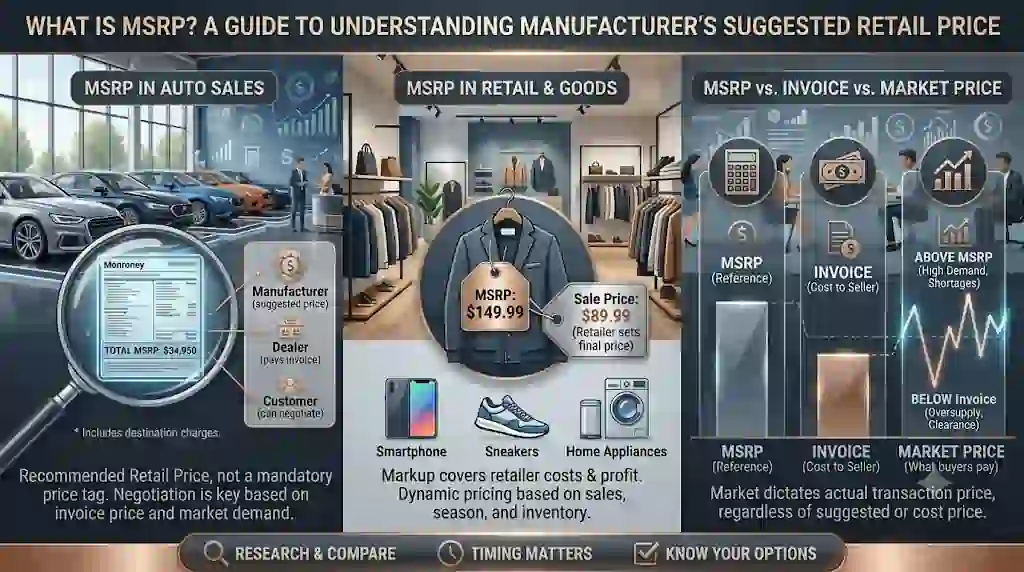
Walking into a dealership without understanding vehicle MSRP meaning hands thousands of dollars directly to the salesperson. The car MSRP meaning centers on the base price of the vehicle plus any factory-installed options. That number you see printed on the Monroney sticker includes the destination charge too – the cost to ship that car from the factory to the dealer’s lot.
Here’s where buyers get tripped up. The dealer paid less than that sticker. Dealerships receive invoice pricing from manufacturers, typically several hundred to several thousand dollars below the listed figure. Between the dealer invoice and the suggested retail price sits your negotiation room.
The base MSRP meaning covers the most stripped-down version of the vehicle. No heated seats. No premium paint. No upgraded sound system. Just the core car with standard features. Add-ons push the total upward. A Honda Civic with a base price of $25,000 might reach $32,000 after adding the sport package, leather interior, and premium wheels. Those options change both the car’s value and the dealer’s profit margin.
Vehicle MSRP meaning extends beyond the initial purchase. Insurance companies reference this number when calculating coverage limits. Banks look at MSRP versus the sale price when approving loans. Gap insurance calculations depend on knowing the difference between what you paid and the original suggested price. Even your property tax bill in certain states connects back to this figure.
MSRP Meaning in Retail – How Stores Set Their Starting Prices
Retail operates differently from auto sales, but the core MSRP meaning remains identical. A clothing manufacturer designs a jacket, calculates material costs, labor, shipping, branding, and desired profit, then sets a suggested price. Retailers buy that jacket wholesale – usually paying 40-60% below what the tag suggests. That markup covers the store’s rent, employee wages, returns, and profit.
MSRP meaning in retail touches everything from Nike sneakers to Gucci handbags. The suggested price creates perceived value. A handbag tagged at $2,500 feels luxurious partly because that number exists. Whether anyone pays that full amount depends entirely on demand. Limited releases command full price or higher. Seasonal clearance items sell for fractions of that initial suggestion.
The msrp meaning clothing shoppers encounter follows this model. A shirt might carry a suggested price of $60. The retailer paid $25 for it. During new arrivals, they hold firm at $60. Six weeks later, a 30% off sale drops it to $42. End-of-season clearance pushes it to $29. Throughout this cycle, the original number never changes – only the store’s willingness to discount does.
Understanding retail MSRP meaning helps you recognize genuine deals versus marketing tricks. A “50% off!” sign means nothing if the store inflated the original suggested price. Knowing what competitors charge for identical items reveals whether that discount represents real savings or clever manipulation.
Starting MSRP Meaning – What “Starting At” Actually Tells You
Manufacturers love the phrase “starting MSRP.” Car commercials flash “$22,000 starting MSRP” across the screen while showing a fully loaded model. The vehicle on screen costs $38,000. That starting price refers to the absolute base configuration – often a version few buyers actually want.
Starting MSRP meaning boils down to the cheapest possible entry point into a product line. For cars, expect manual transmissions, cloth seats, steel wheels, and zero optional equipment. For electronics, think the graphics card without factory overclocking. For appliances, picture the basic model lacking smart features or premium finishes.
This entry-level price serves two purposes. First, it grabs attention in advertisements. Second, it establishes the product line’s price floor. From there, trim levels, packages, and options stack additional costs. A truck might start at $35,000 but reach $72,000 with the premium trim, diesel engine, off-road package, and luxury interior group.
Smart shoppers research what comes standard at that starting price. Does it include the features you actually need? Can you live without the expensive add-ons? Sometimes the base configuration delivers tremendous value. Other times, stepping up one trim level bundles must-have features at a reasonable increase over the foundation model.
MSRP vs Invoice vs Market Price – The Three Numbers That Matter
Three distinct prices matter when evaluating any purchase decision. First comes the manufacturer’s suggested retail price – the public-facing number everyone sees. Next sits the invoice price – what the retailer actually paid the manufacturer. Finally, market price represents what buyers currently pay in the real world.
Invoice pricing stays hidden in most retail transactions. Clothing stores don’t share their wholesale costs. Car dealers guard invoice numbers, though services like Kelley Blue Book and Edmunds reveal them for vehicles.
The gap between invoice and suggested price varies dramatically by industry. Cars might carry 3-8% margins. Luxury goods push 50% or higher. Jewelry often reaches 70-80% markups from wholesale to suggested retail.
Market price ignores both the suggested and invoice numbers entirely. When demand overwhelms supply, market price soars above MSRP. PlayStation 5 consoles at launch. Popular new car models during chip shortages. Limited-edition sneakers. The reverse happens too. Unpopular models, overstocked items, and last-generation technology sell far below suggested prices regardless of what manufacturers recommend.
Total MSRP meaning encompasses the complete suggested price including all options, packages, and fees. A car’s total figure might include $2,000 for the technology package, $1,500 for premium paint, $800 for upgraded wheels, and $1,095 for destination charges on top of the base number. This final tally sets the starting point for negotiations – not the bare-bones starting price advertised in bold letters.
How Manufacturers Calculate Their Suggested Prices
The formula behind suggested retail prices combines hard numbers with strategic positioning. Manufacturing cost forms the foundation – raw materials, assembly labor, factory overhead. Research and development investment spreads across projected unit sales. Marketing budgets factor in. The target profit margin layers on top.
But psychology plays an equal role. $29,999 sounds dramatically cheaper than $30,000 despite the single-dollar difference. Products priced at $499 feel like they belong in a different category than those at $500. These psychological thresholds influence nearly every suggested price you encounter.
Brand positioning shapes pricing strategy too. Lexus and Toyota share platforms, factories, and components. Yet Lexus vehicles carry substantially higher suggested prices. The difference reflects brand perception, dealership experience expectations, and target customer willingness to pay. The manufacturing cost gap between a Toyota Avalon and Lexus ES runs much smaller than their price gap suggests.
Competitive analysis enters the equation. A manufacturer launching a new midsize SUV studies what Honda, Toyota, Ford, and Hyundai charge for comparable models. Pricing too high kills sales volume. Pricing too low leaves profit on the table. The sweet spot accounts for feature advantages, brand strength, and market positioning relative to established competitors.
MSRP Meaning in Specific Markets – Pokémon, GPUs, and Beyond
Not every product category treats suggested retail prices the same way. The msrp meaning Pokémon collectors encounter differs completely from what car buyers experience. Pokémon card packs carry printed suggested prices, but the secondary market operates on entirely different rules. Rare cards sell for hundreds or thousands of dollars regardless of what the original pack cost.
The msrp meaning GPU shoppers face has become notorious. Graphics card prices during the 2020-2022 shortage doubled or tripled above manufacturer suggestions. NVIDIA announced a GeForce RTX 3080 at $699 suggested price. Actual purchase prices reached $1,800 or higher. This disconnect between suggested and real-world pricing frustrated buyers enormously. The manufacturer’s number became almost meaningless when supply couldn’t come close to meeting demand.
Medical equipment follows yet another pricing model. The msrp meaning medical industry professionals reference often bears little resemblance to what hospitals and clinics actually pay.
Group purchasing organizations negotiate steep discounts. Insurance reimbursement rates create additional pricing layers. A surgical device might carry a $5,000 suggested price while hospitals pay $2,100 through their purchasing contracts.
Understanding these category-specific differences prevents costly assumptions. What holds true for negotiating a car purchase doesn’t apply to buying collectibles. The same four-letter acronym carries vastly different weight depending on where you encounter it.
How to Use MSRP in Your Negotiation Strategy
Walking into any major purchase armed with price knowledge transforms your negotiating position. Start by researching the complete pricing picture: suggested retail price, invoice cost, current market conditions, and competitor pricing for identical or comparable items.
For vehicle purchases, request the out-the-door price rather than focusing solely on the suggested number. Dealers sometimes agree to sell at or below invoice but add documentation fees, advertising charges, and mandatory add-ons that push the final price higher than if you’d paid full suggested retail elsewhere. The total cost matters more than any individual line item.
Timing affects how much flexibility exists on suggested prices. Shopping for cars in December brings clearance motivation as dealers push to meet year-end targets. Purchasing winter clothing in February means retailers want that inventory gone before spring shipments arrive. Buying last year’s model of any product typically yields substantial savings below original suggested prices.
Never reveal what monthly payment you can afford. Salespeople convert that information into higher total prices by extending loan terms. Focus negotiation entirely on the actual sale price relative to the suggested figure. Financing discussions happen separately once you’ve locked in the purchase number.
Common Misconceptions About Manufacturer Suggested Retail Price
Many shoppers believe paying MSRP represents getting ripped off. This oversimplification ignores reality. On hot-selling vehicles with waiting lists, paying exactly the suggested price qualifies as a great deal. Some buyers willingly pay above MSRP for the privilege of getting hard-to-find models immediately. Paying MSRP on a Toyota GR Corolla or Ford Bronco at launch beat paying $5,000 over, which many buyers did.
Another misconception: dealers lose money selling below invoice. Dealerships receive holdback payments from manufacturers – typically 2-3% of the suggested price – paid quarterly based on sales volume. They earn financing kickbacks when customers use dealership-arranged loans. Extended warranties, fabric protection, rustproofing, and other add-ons generate significant profit. A deal at or slightly below invoice still makes money for a well-run dealership.
The final misconception suggests prices protect consumers. They serve as reference points – nothing more. Smart buyers view them as starting positions for negotiation, comparison tools between similar products, and benchmarks for evaluating whether a deal genuinely represents good value. They never treat suggested prices as mandatory requirements.
The History of Manufacturer Suggested Retail Pricing
Suggested retail pricing emerged from the automobile industry during the mid-20th century. The Monroney sticker, named after Oklahoma Senator Almer Stillwell Monroney, became mandatory for new vehicles sold in America starting in 1958. The Automobile Information Disclosure Act required manufacturers to display specific information including the suggested retail price on every new car.
This transparency legislation responded to deceptive pricing practices that confused consumers. Before the Monroney sticker requirement, buyers had no standardized reference for what vehicles should cost. Dealers made up numbers. The sticker gave consumers a factual starting point for evaluating deals.
Other industries adopted suggested pricing models voluntarily. Retail price maintenance – manufacturers dictating exact selling prices to retailers – was once common but faced legal challenges. Today’s system allows manufacturers to suggest while retailers set final prices independently. This arrangement creates the dynamic pricing environment consumers navigate with every purchase.
Digital Age Pricing – When MSRP Becomes Irrelevant
Online commerce disrupted traditional suggested pricing models. Dynamic pricing algorithms adjust product costs in real-time based on demand, competitor movements, inventory levels, and individual browsing history. Amazon changes prices millions of times daily. The concept of a fixed suggested retail price crumbles when algorithms optimize pricing by the minute.
Direct-to-consumer brands skip the suggested retail framework entirely. Warby Parker, Casper, and similar companies manufacture products and sell directly to customers. No wholesale pricing exists because no intermediary retailer participates. These brands often compare their prices against what traditional retailers would charge – the hypothetical MSRP – to demonstrate value.
Price comparison tools empower consumers to instantly check prices across dozens of sellers. A product’s suggested price becomes one data point among many rather than the dominant reference. Shoppers sort by lowest total cost including shipping, tax, and applicable discounts. The manufacturer’s suggestion carries minimal weight in purchase decisions when alternatives appear side-by-side on screen.
Quick Reference Table – MSRP Across Industries
| Industry | Typical Markup Over Invoice | Negotiation Possible? | Notes |
| New Cars | 3-8% | Yes | Use invoice pricing as target |
| Luxury Cars | 8-15% | Yes | Higher margins mean more room |
| Clothing | 50-100% | Sometimes | Seasonal sales provide best value |
| Electronics | 5-15% | Rarely | Competition drives pricing |
| Jewelry | 50-80% | Often | Significant markup built in |
| Furniture | 40-60% | Often | Floor models offer best deals |
| Appliances | 15-35% | Sometimes | Package deals lower effective price |
| Collectibles | N/A | Depends | Market value ignores original price |
| Medical Equipment | 40-70% | Yes (B2B) | Contract pricing differs from sticker |
Frequently Asked Questions About MSRP Meaning
What exactly is MSRP meaning for car buyers?
The car MSRP meaning represents the manufacturer’s suggested retail price printed on the vehicle’s window sticker. It includes the base vehicle cost, factory-installed options, and the destination charge. Dealers are not required to honor this price. Use it as a negotiation starting point, not a mandatory payment amount.
Does MSRP include tax and registration fees?
The suggested price does not include sales tax, registration fees, documentation charges, or dealer add-ons. These additional costs typically add 8-15% to the total amount you pay. Always request an out-the-door price quote that includes every fee and charge before making a purchase decision.
Why do some products sell above MSRP?
High demand combined with limited supply pushes market prices above suggested retail levels. When more buyers want a product than available inventory, sellers charge premiums. Collectible items, limited-edition releases, and hot new technology products frequently sell above manufacturer suggestions. The suggested number becomes a minimum, not a maximum.
What is the difference between base MSRP and total MSRP meaning?
Base MSRP covers the most basic version of a product with standard equipment only. Total suggested price adds all optional packages, upgrades, accessories, and fees. A vehicle might have a $30,000 base price but reach $42,000 after adding all desired options and packages.
Can dealers legally sell vehicles above the MSRP?
Yes, dealers operate as independent businesses free to set their own pricing. Federal law prohibits manufacturers from controlling dealer pricing through the Robinson-Patman Act and various state franchise laws. Market conditions determine whether dealers charge above, at, or below manufacturer suggestions.
Is paying MSRP ever a good deal?
Paying the exact suggested price represents a fair deal when demand exceeds supply for a particular product. Popular vehicles with waiting lists often sell at or above MSRP. During normal market conditions, negotiate below the suggested number. During shortages, paying MSRP protects you from dealer markups adding thousands to the price.
Tools and Resources for Price Research
Several free resources help consumers research pricing before major purchases. Kelley Blue Book and Edmunds provide detailed new car pricing information including current market values, invoice prices, and what others in your area recently paid. TrueCar aggregates actual transaction data to show realistic pricing expectations.
Consumer Reports publishes detailed product testing and pricing guidance. Their car buying service offers pre-negotiated prices from participating dealers. Costco and Sam’s Club auto programs similarly connect members with dealers offering agreed-upon pricing structures.
For retail purchases, browser extensions like Honey and CamelCamelCamel track price histories across online retailers. These tools reveal whether current prices represent genuine bargains or temporary markups. Google Shopping compares prices across sellers for identical products instantly.
Your Turn – Make That Knowledge Pay Off
Walking into a purchase understanding what those four letters mean transforms you from an uninformed buyer into a prepared negotiator. The manufacturer’s suggested retail price opens the conversation. It never closes it.
Research your target purchase. Know the invoice pricing. Check what others recently paid. Walk in armed with numbers and the confidence to discuss them rationally. Salespeople respect informed customers because they make faster decisions. They dislike informed customers because those customers rarely overpay.
The next time you spot a window sticker, a price tag, or an online listing showing a suggested retail price, you’ll know exactly what that number represents. A suggestion. Nothing more. Nothing less. And knowing the difference keeps money where it belongs – in your pocket, not added to someone else’s profit margin.