Mood Necklace Colours and Meanings: Your Complete Emotional Colour Chart
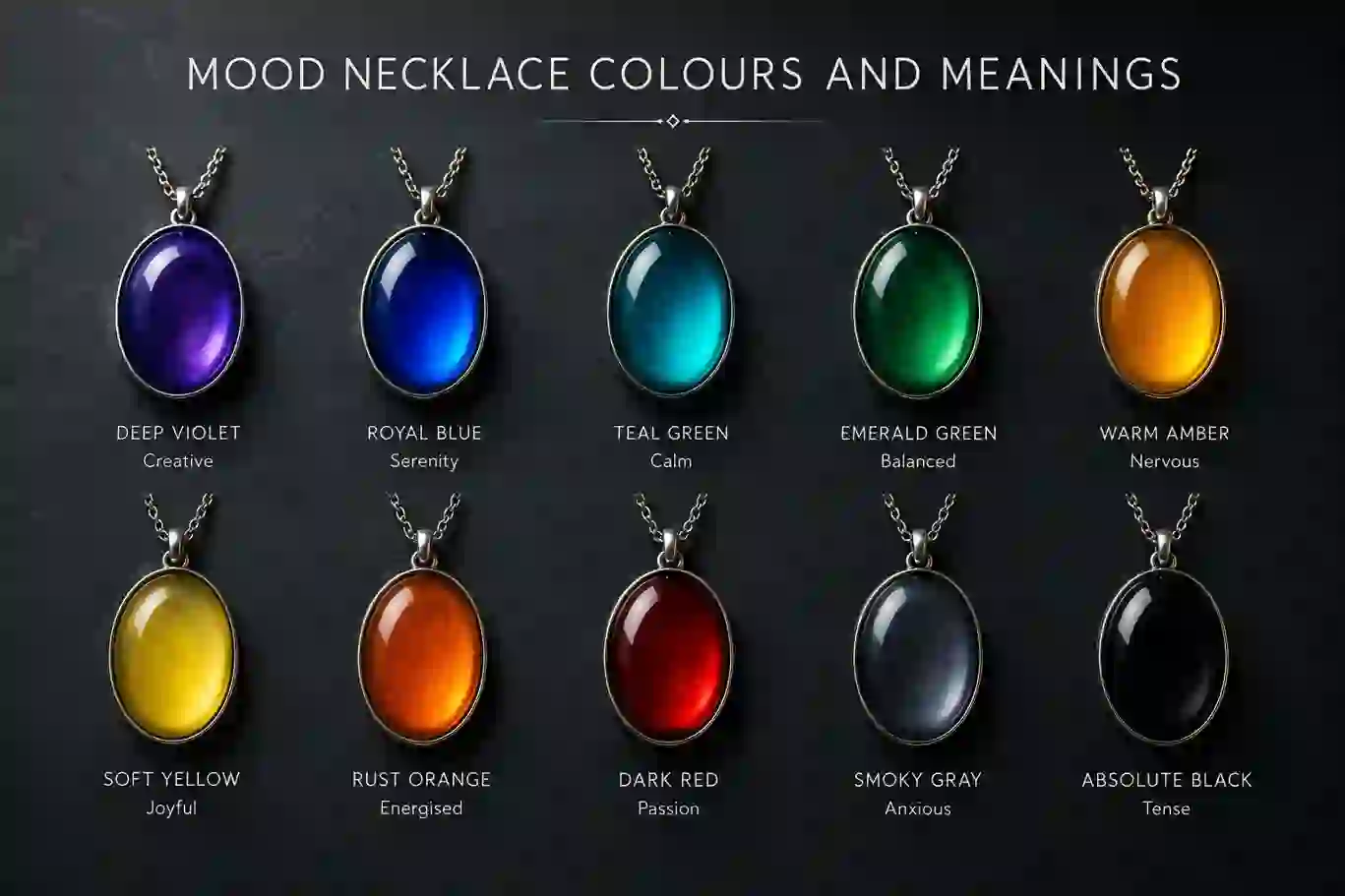
Remember pressing that silver pendant in middle school, waiting for it to turn a deep, magical blue? You weren’t just wearing a piece of jewellery. You were wearing a tiny, temperature-sensitive window into your soul. Decoding mood necklace colours and meanings feels like reading a secret language only you can understand.
These aren’t just relics of the 90s. They’re wearable biofeedback tools that react to your body’s thermal shifts. Forget generic definitions you’ve read before. We’ve built a hyper-specific guide that cuts through the myths and gives you the raw, honest truth behind every shade. Whether you’re feeling stressed, passionate, or blissfully calm, this is the only chart you’ll ever need.
The Real Science Behind Mood Necklace Colours and Meanings
Let’s kill the magic trick right away: the jewellery isn’t reading your mind. It’s reading your blood flow. A mood necklace contains thermotropic liquid crystals encased in clear quartz or glass. These crystals twist and reflect light differently depending on your exact skin temperature.
When you’re anxious, your capillaries constrict, pulling blood away from the extremities. The pendant gets colder, shifting the “mood necklace colours and meanings” to gray or black. When you’re excited or feeling romantic, blood rushes to the surface, warming the stone to a vivid violet or blue. It’s science, but it feels beautifully personal.
A Note on Accuracy from Materials Experts
Dr. Linda Hart, a polymer chemist specializing in liquid crystal technology, explains the mechanism bluntly: “These crystals aren’t analyzing neurotransmitters. They’re thermal mapping devices.
A cold breeze or a fever will hijack the ‘mood’ instantly.” (Source: American Chemical Society, Materials Division). This means your mood necklace colours and meanings rely heavily on context. A black stone in a freezing room means you need a jacket, not a therapist.
The Ultimate Mood Necklace Colours and Meanings Chart
Stop squinting at vague colour gradients. This detailed table strips away the guesswork. Pin this page for the next time your necklace throws you a curveball.
| Colour Shade | Core Emotional Meaning | Physical Trigger | The Deeper Vibe |
| Deep Violet | Passion, Intense Love, Euphoria | Rising skin temperature, racing pulse | Romantic energy or creative fire |
| Royal Blue | Happiness, Joy, Optimism | Steady, warm blood flow | Feeling “in the zone” and carefree |
| Teal Green | Relaxed, Centered, Engaged | Cooler than blue, but above baseline | Intellectual calm; minor curiosity |
| Emerald Green | Neutral, Alert, Focused | Average resting temperature | No strong agitation; a clean slate |
| Warm Amber | Uncertainty, Bewilderment | Mixed signals, fluctuating temps | You’re on the fence about something |
| Soft Yellow | Thoughtful, Analytical, Distracted | Slightly cool, mental processing | Daydreaming or solving a quiet problem |
| Rust Orange | Fear, Nervous Anticipation | Significant temperature drop | Pre-date jitters or public speaking dread |
| Dark Red | Anger, Frustration, Aggression | Hot spots mixed with tension | A warning sign of building pressure |
| Smoky Gray | High Stress, Anxiety, Strain | Constricted blood vessels | Overwhelmed by surroundings |
| Absolute Black | Exhaustion, Burnout, Depression | Extremely cold surface temperature | Emotional or physical drain |
Why Black Is the Most Misunderstood Shade
Black is terrifying on a mood ring, but it’s rarely as dark as it seems. In the world of mood necklace colours and meanings, black often indicates a massive thermal crash. You might be burnt out after a long exam, not fundamentally broken.
Dr. Robert Greene, a neurologist studying stress responses, notes: “Peripheral vasoconstriction—shutting down blood supply to the limbs—is a primal fight-or-flight response. It doesn’t always equal sadness; often, it equals survival mode.” (Source: Journal of Behavioral Neurology). If your necklace goes black, warm your hands with a hot drink. If the colour blooms back to green, you were just cold, not depressed.
Connecting Emotion to Thermochromic History
The original mood ring invention (1975) by Joshua Reynolds never intended to be a serious medical device. Yet, the allure of mood necklace colours and meanings persists because humans crave visible validation of invisible feelings. Marisabel Cabrera, a designer reviving vintage mood jewellery, told Modern Jeweler Magazine: “We’re visual creatures. Seeing anxiety manifest as gray makes it tangible, something you can fight against. That’s the timeless power here.” (Source: Modern Jeweler, Spring 2024 Edition).
10 Authentic Emotional States Your Necklace Reveals Today
Forget the standard clichés. Based on how body heat actually works, here’s what you’re experiencing right now.
- Vibrant Violet (You’re On Fire)
You aren’t just happy; you’re euphoric. Violet emerges during a surge of adrenaline linked to desire or a massive creative breakthrough. - Deep Blue (Soaking in Serenity)
True calm.This color is your “Sunday morning with coffee” color. You aren’t sleeping, but you’re utterly content. - Glass Green (The Reading State)
Your body is stationary, your mind is absorbing words (like this article), and your metabolism is balanced. It’s the colour of learning. - Muddy Amber (The Overthinker)
You’re stuck in limbo. Choosing a restaurant or making a big life decision can cause this mixed thermal signal. - Stormy Gray (The Deadline Clock)
You feel the walls closing in. Gray means your sympathetic nervous system just took the wheel. - Crimson Red (The Pressure Cooker)
High energy, but the chaotic kind. Red is an active, hot anger—often seen right before an argument. - Butter Yellow (Scattered Thoughts)
Multitasking hell. You’re juggling five things, feeling mildly clever but slightly lost. - Midnight Black (The Void)
You’ve hit a wall. Stop checking the colour and go eat a solid meal or take a nap. - Aqua Teal (Open-Hearted)
You’re approachable. People feel safe talking to you because your physical state is open and vulnerable. - Burnt Orange (The Anticipator)
You’re scared but excited. This is the “roller coaster climb” feeling captured in a crystal.
How to Manipulate the Colour (For Fun)
You can game the system. These mood necklace colours and meanings shift instantly if you manipulate the temperature. Place it against an ice-cold soda can to force a deep black, or breathe hot air slowly onto the crystal to create a loving violet. Kids used to do this to trick friends into thinking they had a crush. It’s a fun reminder that the ring reads physics, not fate.
Choosing Your First Mood Necklace Today
Not all pendants are equal. The sensitivity of the liquid crystals dictates how quickly you see the mood necklace colours and meanings change.
- Classic Oval Glass: Responds rapidly to slight thermal shifts. Perfect for spotting fleeting emotions.
- Silver Caged Dome: Conducts heat faster from the skin, making the readings more stable and less jumpy.
- Resin-Coated Beads: Slower reaction time. Often stays one colour longer, giving a “general mood for the hour.”
Always test a new necklace by holding it under cool tap water (should go black/gray) and then pressing it into your palm (should go blue/green). If it stays stagnant, the crystals are dead.
Self-Care Meets Wearable Tech
We spend thousands on smartwatches to track steps and heart rate variability. A mood necklace costs far less and does something a silicon gadget often can’t: it forces you to pause. Checking your mood necklace colours and meanings is a mindfulness check-in. Ask yourself: Does the colour match how I actually feel inside? If your necklace is red but you swear you’re calm, your body is lying to you. That’s a signal to breathe deeper.
Frequently Asked Questions (FAQs)
What triggers mood necklace colours and meanings to change?
Body temperature alone triggers the shift. Liquid crystals in the necklace twist under heat variations from your blood flow, instantly altering the visible colour. External weather can also override a “true” emotional reading.
Why does my mood necklace only show black?
Your hands are likely cold, or you’re experiencing high vasoconstriction from stress. Black is very common in air-conditioned rooms. Warm your skin externally first; if it stays black, you’re probably tense.
Do mood necklace colours and meanings actually reflect real emotions?
Indirectly, yes. While the necklace can’t sense dopamine, your emotional state (fear, excitement, calm) directly changes your circulation. The colour visualizes the physical symptom of that emotion, not the abstract thought itself.
Are blue and green the healthiest colours on a mood necklace?
Usually, blue indicates a happy, warm, relaxed state, and green means a calm, neutral balance. These are considered “positive” stable zones, free from extreme stress or overwhelming excitement.
Can you permanently change mood necklace colours and meanings?
No. The liquid crystals are completely reversible. They will keep shifting between colours millions of times over the necklace’s lifetime as long as the glass casing isn’t cracked.
Do mood necklace colours and meanings differ between brands?
The core thermal spectrum (black to violet) is universal science. However, cheap knock-offs might skip certain vivid greens or blues, jumping abruptly from amber to violet due to lower-quality crystals.
The Simple Truth About Your Shifting Colours
The beauty here isn’t the accuracy. It’s the conversation. Your necklace won’t fix your anxiety or make you fall in love. But it gives you a pause button. Next time you glance down and see that murky amber or stormy gray, don’t scroll past it.
Identify why your blood just ran cold. This is emotional intelligence, wrapped in 1970s retro nostalgia. Wear that spectrum proudly, understand what it whispers, and let today’s colour guide your next deep breath. Grab your necklace, watch the violet bloom, and own the feeling.