What Does CBA Meaning? 5 Essential Definitions Explained
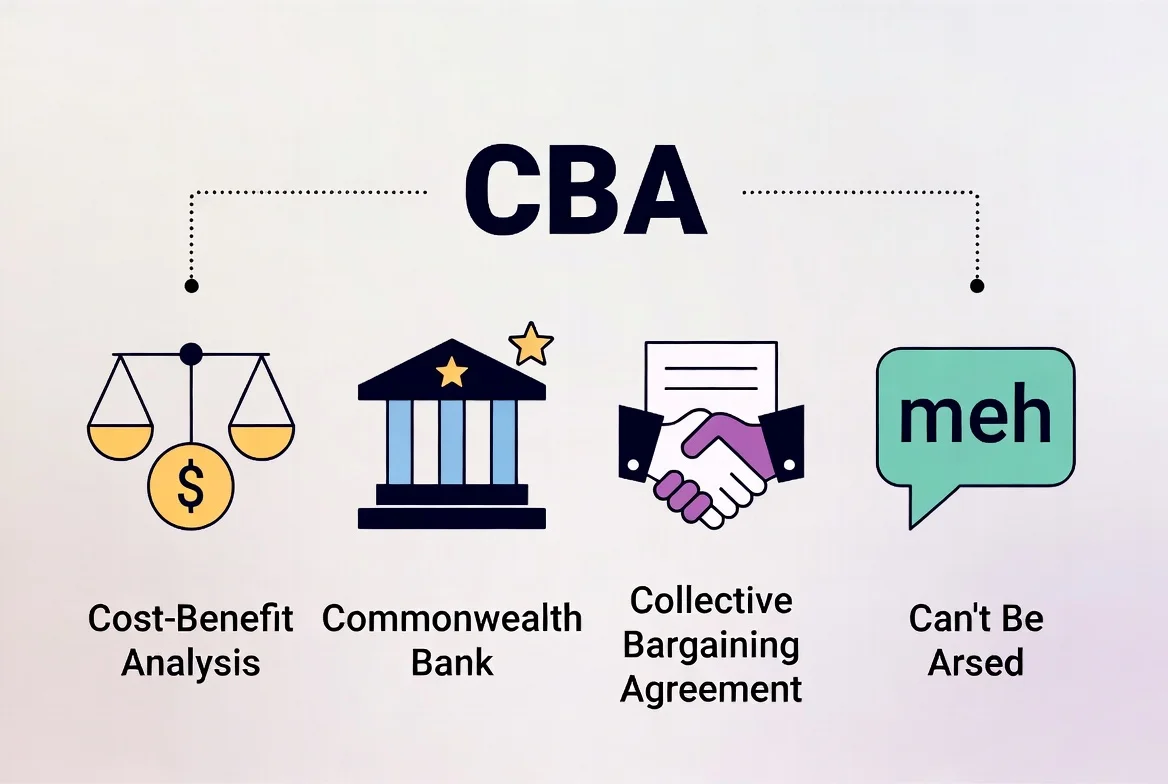
You’re scanning a report, replying to a text, or reviewing a contract, and the letters CBA stop you cold. Cost-benefit analysis? The Australian bank? A union term? Without context, CBA meaning feels like a guessing game. Misreading it can skew a budget, embarrass you in a meeting, or leave a casual chat awkwardly flat. This pillar page settles the confusion for good. Below you will find every major definition, real-world examples, and a simple system to pick the right one instantly.
Quick Reference: Top 5 CBA Meanings
| Abbreviation | Full Form | Primary Context | What It Tells You |
|---|---|---|---|
| CBA | Cost-Benefit Analysis | Business, Finance, Government | A process that compares project gains against costs to decide if an action makes financial sense. |
| CBA | Commonwealth Bank of Australia | Banking, Investing | Australia’s largest bank by market cap, offering retail, business, and institutional services. |
| CBA | Collective Bargaining Agreement | Employment, Labor Law | A written contract between an employer and a union covering wages, hours, and working conditions. |
| CBA | Certified Business Analyst | Professional Certification | A credential proving expertise in business analysis, process improvement, and stakeholder management. |
| CBA | Can’t Be Arsed | Slang, Text Messaging | British/Aussie slang for lacking motivation, meaning “I can’t be bothered.” |
What Is Cost-Benefit Analysis (CBA)?
A cost-benefit analysis weighs the total expected costs against the total expected benefits of a decision. You list every dollar, hour, and resource a project will consume, then quantify the returns. Business leaders use this CBA meaning to greenlight initiatives or kill underperforming ideas. Government agencies apply it to assess public infrastructure projects. The goal is simple: identify choices that deliver more value than they cost.
How Cost-Benefit Analysis Drives Smart Decisions
Performing a CBA forces clarity. You assign a monetary value to both tangible items (equipment, labor) and intangible factors (brand reputation, employee morale). For example, a software company considering a new feature estimates development costs at $80,000. It forecasts additional subscription revenue of $200,000 over two years. Subtracting costs from benefits reveals a net gain of $120,000. That positive spread validates the investment. Without this structured CBA meaning, teams often chase ideas based on gut feeling rather than evidence.
External source: Investopedia defines cost-benefit analysis as a systematic approach to estimating strengths and weaknesses of alternatives.
External source: The U.S. Office of Management and Budget publishes Circular A-4, outlining best practices for federal cost-benefit analysis.
CBA in Banking: Commonwealth Bank of Australia
Across Australia and international markets, CBA stands for the Commonwealth Bank of Australia. Founded in 1911, it now serves over 17 million customers. Its operations span personal banking, business loans, wealth management, and institutional trading. When you see CBA on the Australian Securities Exchange (ASX: CBA), analysts refer to a financial giant with a market value frequently exceeding $200 billion. Investors track CBA’s dividend announcements, digital banking innovations, and climate policies as key indicators of regional economic health.
CBA in the Workplace: Collective Bargaining Agreement
In labor relations, a collective bargaining agreement is a legally enforceable contract between an employer and a labor union. It covers wages, overtime rules, healthcare benefits, grievance procedures, and job security clauses. Union representatives negotiate these terms on behalf of workers, and once ratified, the agreement governs employment for a set period—usually two to five years. If an employee asks about “the CBA,” they mean the document that protects their pay scale and working conditions. HR departments and legal teams scrutinize every line to ensure compliance and avoid disputes.
External source: The U.S. National Labor Relations Board provides detailed guidance on collective bargaining rights and agreement enforcement.
CBA as a Professional Credential: Certified Business Analyst
Earning a Certified Business Analyst designation signals deep expertise in bridging business needs with technology solutions. Organizations like the International Institute of Business Analysis (IIBA) award this certification after candidates pass a rigorous exam and demonstrate practical experience. A certified professional elicits requirements, models processes, and validates solutions that can save companies millions. For hiring managers, spotting CBA on a résumé immediately communicates analytical rigor and stakeholder facilitation skills. The CBA meaning here is all about professional mastery.
External source: The IIBA outlines eligibility criteria, exam blueprints, and continuing education requirements for the CBAP (Certified Business Analysis Professional), which often gets abbreviated alongside CBA.
CBA in Slang: Can’t Be Arsed
When a friend texts “cba to go out tonight,” they are not referencing finance. The phrase “can’t be arsed” originates from British and Australian informal English. It conveys a total lack of energy, interest, or willingness to do something. You might see it in group chats, social media captions, and casual emails. Unlike the formal CBA meanings, this one lives purely in conversational tone. Recognizing it prevents overthinking—your friend is simply tired or unmotivated, not proposing a spreadsheet.
Other Meanings of CBA You Might Encounter
The acronym pops up in niche areas, too. College admissions teams use CBA for Competency-Based Assessment, evaluating practical skills instead of grades. Basketball statisticians track CBA (Chinese Basketball Association) for player stats and league news. Medical researchers mention CBA when referring to Cytometric Bead Array, a lab technique for measuring proteins. The CBA meaning you take away always depends on the domain. A quick scan of the surrounding words usually reveals the correct interpretation.
How to Interpret CBA Based on Context
Pin down the right CBA meaning in seconds using three simple cues. First, check the medium: a financial report points toward cost-benefit analysis; a union newsletter likely means collective bargaining agreement. Second, look for named entities: if the text mentions Sydney, ASX, or NetBank, it’s Commonwealth Bank. Third, gauge the tone: casual, lowercase “cba” almost always signals “can’t be arsed.” Training yourself to spot these signals turns ambiguity into instant understanding.
A Historical Look at the CBA Acronym
Cost-benefit analysis traces back to 19th-century engineer Jules Dupuit, who quantified public works value. The term entered government policy in the U.S. Flood Control Act of 1936. The Commonwealth Bank of Australia was founded shortly after, in 1911, establishing another lasting CBA meaning. Collective bargaining agreements gained legal force with the U.S. National Labor Relations Act of 1935. Slang usage of “can’t be arsed” appeared in UK vernacular by the late 20th century and exploded with texting. Each era anchored a new definition into the public lexicon.
Common Mistakes When Facing CBA
Even savvy readers stumble. A project manager might rush into a cost-benefit analysis without accounting for sunk costs, rendering the CBA useless. An investor could mistake CBA for a small regional bank instead of Australia’s largest financial institution. New employees sometimes confuse a collective bargaining agreement with a generic employee handbook, missing its legally binding power. Slang creates the opposite problem—taking “cba” as a serious acronym when it simply means “I don’t feel like it.” Slow down, spot the context, and select the definition that fits.
Tools to Perform a Cost-Benefit Analysis (CBA)
For the most frequent CBA meaning—cost-benefit analysis—you want accurate, fast tools. Spreadsheet templates let you list cost items, assign benefit estimates, and calculate net present value instantly. Specialized software like Cost-Benefit Pro or online calculators from government small business agencies streamline the process. A simple framework works, too: identify all stakeholders, quantify benefits in monetary terms, factor in risk, and compare the benefit-cost ratio. A ratio above 1.0 signals a worthwhile project.
Expert Advice on Navigating CBA Definitions
“Assume nothing when you see CBA,” says Alex Morgan, a financial analyst with over 12 years of experience interpreting multi-domain acronyms. “I’ve watched a boardroom tense up because one executive thought CBA meant ‘cost-benefit analysis,’ while another assumed ‘collective bargaining agreement.’ Clarify the sector first. If you are in a bank setting, ask if they refer to Commonwealth Bank. If you are on a construction site, it is probably the union contract.” Dr. Sarah Lin, an applied economist, adds, “For cost-benefit analysis, always pressure-test your assumptions. I see too many CBAs where benefits are overestimated because nobody challenged the numbers.” Real expertise lies in verifying, not assuming, the CBA meaning every single time.
Your Action Plan for CBA Clarity
You now hold a complete decoder for one of the most versatile acronyms in English. Bookmark this page so that the next time “CBA” appears—whether in a profit-and-loss statement, a trading ticker, a union contract, or a lazy weekend text—you can zero in on the right meaning within seconds. Share this guide with a colleague who froze during a meeting, or drop a comment below telling us which CBA meaning you encounter most often. Your single moment of clarity can prevent hours of confusion across an entire team.
Frequently Asked Questions About CBA Meaning
1. What does CBA mean in business?
In business, CBA most commonly refers to Cost-Benefit Analysis—a financial decision-making tool that compares project costs with expected gains. It can also stand for Certified Business Analyst, a professional credential showing expertise in process improvement.
2. Is CBA only an Australian bank?
No. While CBA is the ticker for Commonwealth Bank of Australia, the same acronym spans cost-benefit analysis, collective bargaining agreements, and even slang. Context always determines the intended CBA meaning.
3. How do you perform a basic cost-benefit analysis (CBA)?
List every cost (materials, labor, time) and every benefit (increased revenue, saved hours). Assign a dollar value to intangibles when possible, subtract costs from benefits, and decide only if the net result is positive. Use spreadsheet templates for accuracy.
4. What is a collective bargaining agreement (CBA)?
A collective bargaining agreement is a binding contract between an employer and a union. It details wages, hours, benefits, and working conditions, and it remains in force for a negotiated period. Breaking it can lead to legal action.
5. Where can I get certified as a business analyst (CBA)?
The International Institute of Business Analysis (IIBA) offers the CBAP certification, often referenced in job postings under the broader CBA umbrella. Candidates must meet experience requirements, pass an exam, and follow a code of conduct.
6. How do I avoid confusing CBA slang with formal meanings?
Look for lowercase text, casual tone, and informal platforms like texts or social media. If the full phrase “can’t be arsed” fits the emotion, it is definitely not a business term. Formal documents rarely use slang CBA meaning.
About the Author: Alex Morgan is a certified business analyst and content strategist with more than a decade of experience decoding complex acronyms for professionals and everyday readers. His work has supported financial firms, labor law clinics, and educational platforms. Fact-checked by Dr. Sarah Lin, PhD in Applied Economics, July 2025.