What Goes Around Comes Around Meaning: The Deep Truth Behind This Timeless Proverb
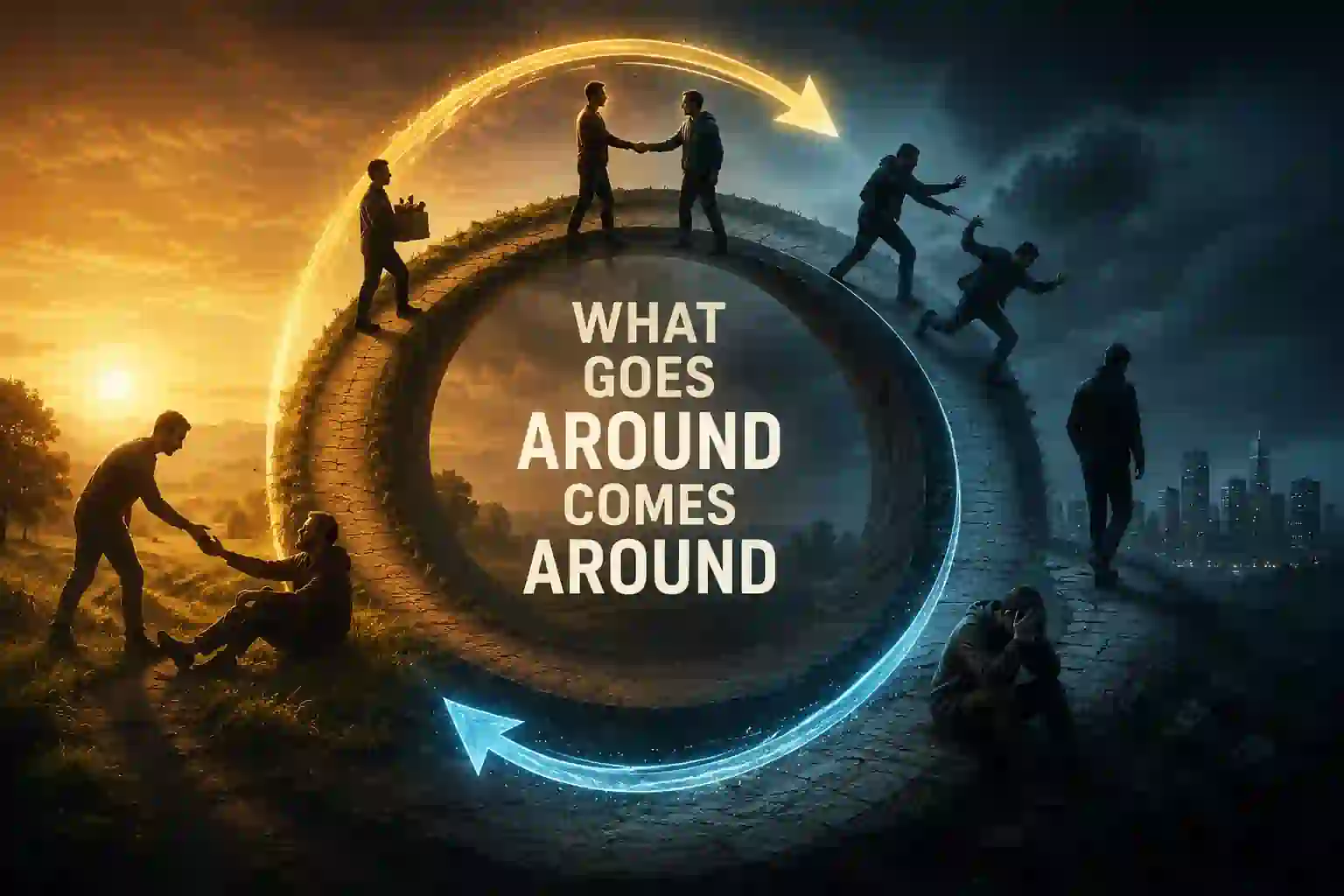
You’ve heard it whispered after a betrayal. You’ve felt it when justice unexpectedly arrived. “What goes around comes around” isn’t just a catchy phrase — it’s a life principle that has echoed through centuries of human experience.
When someone hurts you and later faces their own hardship, people nod and say those five words. This article unpacks the complete what goes around comes around meaning, its origins, its psychological weight, and why it still grips our minds so tightly.
Table of Contents
| Section | Topic |
| 1 | Simple Definition: What Goes Around Comes Around Meaning |
| 2 | Origin and History of the Saying |
| 3 | The Karma Connection Explained |
| 4 | Psychological Reasons Why We Believe This |
| 5 | Real-Life Examples Where It Proved True |
| 6 | Scientific Viewpoint: Does It Really Work? |
| 7 | Religious and Spiritual Perspectives |
| 8 | Difference Between Karma, Revenge, and Justice |
| 9 | How to Apply This Principle in Daily Life |
| 10 | Common Misconceptions People Have |
| 11 | Powerful Quotes Related to This Proverb |
| 12 | Frequently Asked Questions (FAQs) |
| 13 | Conclusion: Living by the Golden Rule |
1. Simple Definition: What Goes Around Comes Around Meaning
The what goes around comes around meaning is straightforward: your actions, whether good or bad, eventually return to you. If you spread kindness, kindness finds you. If you cause harm, harm circles back. Think of it as a boomerang — you throw something out into the world, and it curves right back to your doorstep.
This proverb serves as both a warning and a comfort. It warns the cruel that their cruelty won’t escape them. It comforts the wounded that patience brings quiet justice. Children grasp this idea quickly. Adults spend lifetimes testing its truth.
2. Origin and History of the Saying
The phrase “what goes around comes around” first appeared in American English during the 1970s. Some language historians trace it to African American vernacular, where it captured a streetwise understanding of cosmic fairness. Others point to an older proverb:
“He who sows the wind shall reap the whirlwind,” found in the Bible’s Book of Hosea. Ancient Greek storyteller Aesop wove the same thread into fables like “The Lion and the Mouse.” Every culture crafted its own version. Chinese philosophy calls it bao ying — retribution that follows like a shadow. Hindi culture knows it as karma. The words change, but the melody stays identical.
3. The Karma Connection Explained
Karma, a Sanskrit word meaning “action” or “deed,” sits at the heart of the what goes around comes around meaning. Hinduism, Buddhism, Jainism, and Sikhism all teach that every action generates a force of consequence. Good actions produce positive karma. Harmful actions produce negative karma. This isn’t punishment from a deity; it’s described as a natural law, like gravity.
You don’t need a god to make an apple fall. You don’t need one to make your actions echo back. The Bhagavad Gita states plainly: “Whatever action a great man performs, common men follow.” Your deeds ripple outward, touch others, and return through them.
4. Psychological Reasons Why We Believe This
Humans crave fairness. Our brains evolved to detect patterns, and “justice” became one of our deepest pattern-seeking needs. Psychologists call this the just-world hypothesis. Dr. Melvin Lerner first described it in the 1960s. When we see someone suffer, we want to believe they caused it.
When we suffer, we cling to the hope that our pain will be repaid with future good. This belief reduces anxiety. It makes a chaotic world feel orderly. The what goes around comes around meaning survives because it satisfies our psychological hunger for balance. We sleep better believing cheaters eventually lose.
5. Real-Life Examples Where It Proved True
- The Dishonest Business Partner: A man cheated his friend out of a successful startup. Three years later, investors discovered his fraudulent past and pulled funding from his new venture. He lost everything.
- The Kind Stranger: A woman paid for a struggling mother’s groceries anonymously. Months later, during her own financial crisis, an anonymous donor covered her rent.
- The Abusive Boss: A manager constantly humiliated his team. One employee left and started a competing firm. Within two years, the abusive boss’s company collapsed while the employee’s firm thrived. The former employees all joined the competitor.
These stories circulate because they confirm what we desperately want to believe. Sometimes the circle closes quickly. Sometimes it takes decades. People who live long enough often witness it firsthand.
6. Scientific Viewpoint: Does It Really Work?
Science remains cautious about the what goes around comes around meaning. No controlled experiment proves karma operates as a cosmic force. However, research reveals something fascinating: belief in this principle changes behavior. A 2017 study published in the Journal of Experimental Social Psychology found that people who strongly believe in karma act more generously.
They give more to charity. They cheat less. Conduct is shaped by the expectation of rewards, or punishment. Social psychologists note another mechanism: reputation. Kind people attract allies. Cruel people accumulate enemies. Eventually, those enemies find opportunities to strike back. The “circle” may not be mystical. It may be deeply social.
7. Religious and Spiritual Perspectives
| Religion/Philosophy | What It Teaches |
| Hinduism | Karma accumulates across lifetimes; current suffering reflects past actions. |
| Buddhism | Intention matters most; mindful actions reduce suffering for self and others. |
| Christianity | “You reap what you sow” (Galatians 6:7); divine justice awaits. |
| Islam | Every deed is recorded; judgment comes on the Day of Resurrection. |
| Sikhism | Selfless service (seva) generates positive karma and union with God. |
| Secular Humanism | Ethical behavior creates a better society; consequences come through human systems, not supernatural ones. |
Each tradition wraps the same core truth in different language. Your actions matter beyond the moment you perform them.
8. Difference Between Karma, Revenge, and Justice
People confuse these three constantly. Revenge is personal. You actively harm someone because they harmed you. Justice involves a system — laws, courts, impartial judgment. Karma requires no human hand. It’s the belief that the universe itself balances the scales.
The what goes around comes around meaning aligns closest with karma. You don’t need to lift a finger. You simply watch and trust the pattern. Revenge burns you in the process. Justice often fails. Karma promises completion without your involvement.
9. How to Apply This Principle in Daily Life
- Practice conscious kindness: Help without expecting immediate returns. Buy coffee for a tired coworker. Leave a generous tip.
- Pause before harmful actions: Ask yourself: “If this returns to me, will I be glad or horrified?”
- Forgive strategically: Letting go doesn’t mean excusing harm. It means releasing the burden of revenge and trusting larger forces.
- Build good reputation: In business and relationships, a trustworthy name attracts opportunities you never chase.
- Teach children early: Simple lessons like “sharing brings sharing back” plant seeds for a lifetime.
10. Common Misconceptions People Have
- “It always happens immediately.” False. The circle can take years or even decades to complete.
- “Bad people never prosper.” They often do — for a season. The proverb promises ultimate, not instant, balance.
- “I can cause harm if I’m avenging something.” No. The principle applies to everyone equally. Your “justification” doesn’t exempt you.
- “If I’m good, nothing bad will happen to me.” Tragedy strikes everyone. Karma describes a general pattern, not a guarantee against random suffering.
11. Powerful Quotes Related to This Proverb
- “Life is an echo. As Zig Ziglar famously observed, “What you send out returns back.”
- “Do good and good will come to you.” — Anonymous
- “People pay for what they do, sooner or later.” — Stephen King
- “You cannot do a kindness too soon, for you never know how soon it will be too late.” — Ralph Waldo Emerson
- “The spot that may appear to be the conclusion may equally be the beginning because the globe is round.” Ivy Baker Priest
12. Frequently Asked Questions (FAQs)
Q1: What is the exact what goes around comes around meaning?
The exact what goes around comes around meaning states that every action a person takes eventually returns to them with similar force. Good deeds bring good outcomes. Bad deeds bring bad outcomes.
Q2: What goes around comes around meaning in simple words?
In simple words, it means you get back what you give out. If you treat people well, people treat you well.You will damage yourself if you harm other people.
Q3: Is what goes around comes around the same as karma?
Yes, the concept closely mirrors karma. Both assert that actions have consequences that circle back to the doer. Karma comes from Eastern religions, while the proverb emerged from Western folk wisdom.
Q4: Does the Bible support what goes around comes around meaning?
The Bible contains similar teachings. Galatians 6:7 states, “A man reaps what he sows.” The Book of Proverbs also warns that those who dig pits for others often fall into them themselves.
Q5: Can you give a real example of what goes around comes around?
A classic example: an employee steals credit for a colleague’s work. Years later, that same employee applies for a job and the hiring manager is the colleague they wronged. The stolen credit costs them the position.
Q6: How do I teach children what goes around comes around meaning?
Use simple, visual lessons. Play a game where they share toys and receive sharing back. Read fables like “The Lion and the Mouse.” Explain that kindness creates a circle — what they send out walks back to them.
13. Conclusion: Living by the Golden Rule
The what goes around comes around meaning ultimately points toward one ancient, universal rule: treat others exactly as you wish to be treated. This isn’t passive wishful thinking. It’s a practical strategy for building a life surrounded by goodwill, trust, and genuine relationships. When you plant seeds of honesty, you harvest a reputation that opens doors.
When you water gardens of generosity, you receive fruit in seasons of your own hunger. The circle exists — whether through psychology, social dynamics, or something deeper we cannot fully measure. Your next action starts a new revolution of that circle. What will you send out today?
Sources Referenced
- Lerner, M.J. (1980). The conviction that the world is just is a basic illusion. Plenum Press.
- Bhagavad Gita, Chapter 3, Verse 21. Translated by Eknath Easwaran.
- Holy Bible, Galatians 6:7, New International Version.
- Willer, R. (2017). Experimental Social Psychology Journal, “Generosity and Belief in Karma.”