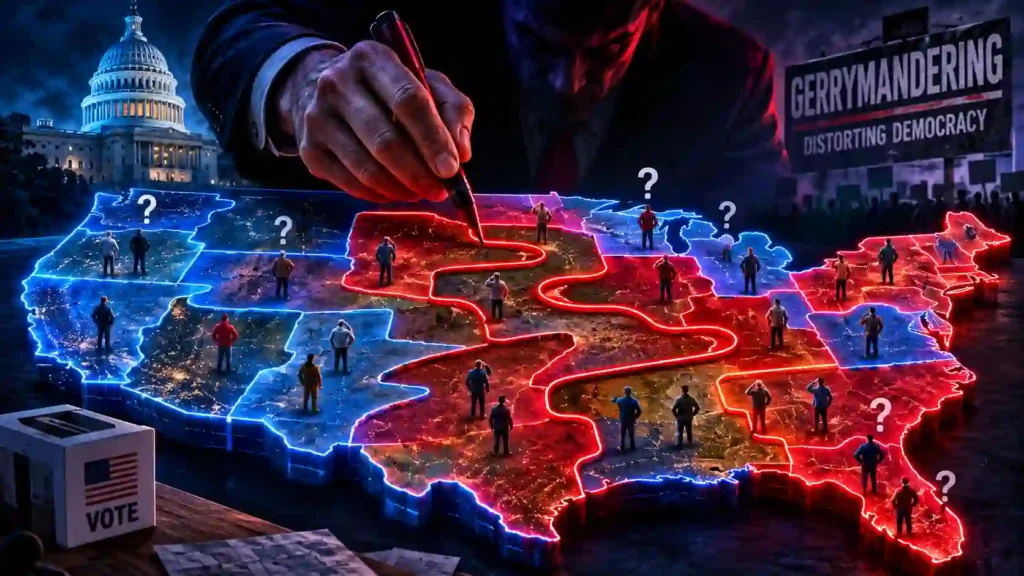
Ever wondered why your vote sometimes feels like it barely counts? The gerrymandering meaning behind that frustration goes deeper than most people realize, and the truth might genuinely shock you.
Politicians have quietly redrawn district maps for over two centuries to lock in power and silence opposition. This article breaks down exactly how the manipulation works behind closed doors and why it directly affects your daily life more than you think.
What Is the Gerrymandering Meaning in Simple Terms?
The gerrymandering meaning boils down to one deceptively simple idea: manipulating electoral district boundaries to favor a specific political party or demographic group.
Instead of letting communities vote fairly, mapmakers twist district lines into bizarre, unrecognizable shapes. These shapes deliberately pack opposition voters into a single district or crack them across many districts to dilute their collective influence.
Think of it like slicing a pizza unfairly at a party. One person grabs all the pepperoni slices while everyone else fights over plain crust. That visual captures the concept perfectly in everyday terms.
Most voters never notice these tricks because the maps look official and legal on paper. The gerrymandering meaning only becomes clear when you compare final election results against actual popular vote totals in a given state.
The Wild History Behind the Gerrymandering Meaning
The gerrymandering meaning traces back to 1812 when Massachusetts Governor Elbridge Gerry signed a bill creating a salamander-shaped voting district that outraged the public.
A sharp-eyed political cartoonist at the Boston Gazette merged “Gerry” with “salamander,” and the term stuck permanently in American political vocabulary. Newspapers reprinted the cartoon nationwide, sparking a firestorm of public anger that still echoes through modern elections.
Since that infamous moment, both major American parties have weaponized redistricting tricks after every single census. The tactics have evolved with technology and data analytics, but the core strategy of rigging maps remains completely identical to what Governor Gerry attempted over 200 years ago.
Two Main Types That Define the Gerrymandering Meaning
Understanding the gerrymandering meaning fully requires knowing its two primary strategies. Each one attacks fair democratic representation in a distinct and devastating way.
Packing crams as many opposition voters as possible into a single district. The opposing party wins that one seat by a massive landslide but loses nearly everywhere else on the map because their supporters got concentrated in one spot.
Cracking splits opposition voters across multiple districts so they never form a winning majority anywhere. Their votes get diluted like a single drop of ink dissolving in a large glass of water, rendering their political voice essentially invisible.
- Packing wastes opposition votes by creating unnecessary landslide victories nobody needs
- Cracking spreads voters thin across districts so they cannot win a single seat
- Both methods mathematically guarantee the map-drawing party keeps legislative control
- Independent redistricting commissions in several states now actively fight these tactics
Gerrymandering Meaning by the Numbers: A Shocking Data Breakdown
Hard numbers reveal just how aggressively politicians exploit the gerrymandering meaning to stay in power decade after decade. The table below highlights key statistics from recent redistricting cycles across heavily manipulated states.
| State | Party in Control | Seats Won | Popular Vote Share | Efficiency Gap |
| North Carolina | Republican | 10 of 13 | 50.3% | +19.4% |
| Maryland | Democrat | 7 of 8 | 60.1% | +15.2% |
| Wisconsin | Republican | 63 of 99 | 52.4% | +12.8% |
| Illinois | Democrat | 14 of 17 | 56.2% | +11.5% |
The efficiency gap column measures wasted votes across districts. Political scientists agree that any gap above 7% signals serious gerrymandering, and every single state listed here blows past that threshold by a wide margin.
What stands out most is that both parties play this game aggressively. The gerrymandering meaning is not a partisan issue — it is a structural power grab that harms voters regardless of which color they lean toward on election day.
How the Gerrymandering Meaning Impacts Your Everyday Life
The gerrymandering meaning is not just a dusty political science term reserved for college textbooks. It directly shapes the roads near your house, the public schools your kids attend, and the local taxes you pay every year.
When politicians get to pick their voters instead of voters picking their politicians, real accountability vanishes overnight. Elected officials stop competing for your support because their safe seat is already guaranteed by the rigged map they helped create.
Communities of color historically suffer the most from these schemes. The gerrymandering meaning often includes deep racial dimensions that weaken minority voting power despite federal legal protections like the Voting Rights Act of 1965.
Final Thoughts on the Gerrymandering Meaning
The gerrymandering meaning should genuinely bother every single voter who cares about fair and honest elections. Politicians will keep rigging maps behind closed doors until ordinary citizens demand real structural change at the state level.
Your smartest move right now is checking whether your state uses an independent commission or still lets self-interested lawmakers draw their own districts. That single piece of information tells you everything about how fair your next election will actually be.
Stay informed, stay loud, and never let a twisted district map silence your voice at the ballot box.