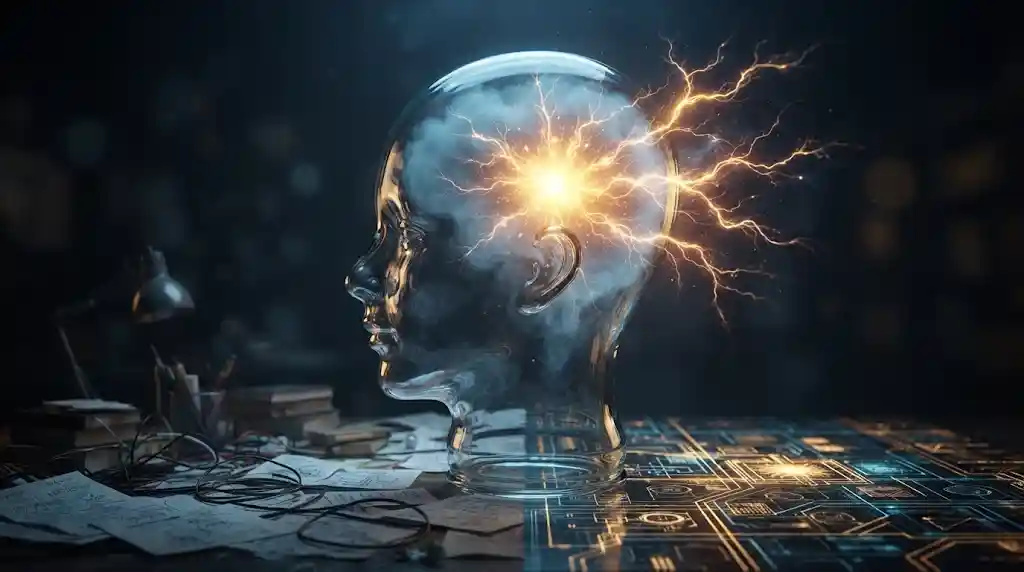
You are stuck. Then, in a flash, the answer lands. No warning. No buildup. Just clarity so sharp it feels like someone flipped a switch inside your skull.
That is the epiphany meaning in its purest form—a sudden, involuntary reorganization of understanding that arrives before you can even explain how you got there. But here is what most people miss: an epiphany is not luck. It is a measurable brain event with a predictable structure. And once you understand that structure, you can stop waiting for lightning to strike and start building the conditions for it.
What Does Epiphany Mean, Really?
The word travels straight from ancient Greek epiphaneia—”appearance” or “manifestation.” Early religious writers used it for divine revelation, the moment a god made itself visible to a human. Over centuries, the term migrated from temples into psychology labs and literature seminars.
Today, the epiphany meaning in everyday language is simpler: a sudden realization that reframes everything you thought you knew. It is seeing the facts you already had in a completely different arrangement.
That distinction matters. Gradual learning adds information brick by brick. An epiphany rearranges the entire building in one breath.
The Neuroscience Behind the Epiphany Meaning
Brain imaging research has tracked what happens in the seconds before someone consciously reports an insight. The finding is almost unsettling: neural activity in the right anterior temporal lobe spikes with a burst of high-frequency gamma waves roughly 300 milliseconds before the person becomes aware of the solution.
In other words, your brain solves the problem first. The “aha” feeling is not the moment of discovery—it is the notification that discovery already happened.
The anterior cingulate cortex flags the gap between what you understand and what the incoming data suggests. The right prefrontal cortex pulls loosely associated ideas together. The hippocampus reaches into long-term memory for distant, seemingly unrelated knowledge. When the pieces lock, dopamine and norepinephrine flood the system, producing that unmistakable rush of certainty and pleasure.
This is why epiphanies feel true before you can justify them. The neurochemistry of reward arrives before the logic catches up.
The Three Faces of Epiphany Meaning in Psychology
Psychologists do not treat all epiphanies as one blob. They separate them into three broad categories based on what gets reorganized—your ideas, your emotions, or your entire identity.
| Epiphany Type | What Shifts | Common Trigger | Typical Outcome |
| Intellectual | A problem’s solution becomes obvious | Focused work followed by mental rest | New problem-solving framework |
| Emotional | Feelings about a person or situation flip | Therapy, conflict, loss, meditation | Reduced inner conflict; changed behavior |
| Existential | Core values and life direction reorganize | Crisis, grief, major transitions | Lasting identity shift and flexibility |
The intellectual type gets the headlines—Archimedes in the bath, Newton under the apple tree. But the emotional and existential types often leave deeper marks. An intellectual epiphany changes what you know. An existential epiphany changes who you are.
Real Epiphanies That Rewired History
The epiphany meaning is not confined to textbooks. It has a track record of interrupting ordinary moments and redirecting entire fields.
- William Rowan Hamilton was walking along Dublin’s Royal Canal in 1843 when “an electric circuit seemed to close.” He had the insight behind quaternion mathematics and carved the equation into a stone bridge on the spot.
- Paul McCartney woke one morning with the melody of “Yesterday” already playing in his head. He was so convinced it was someone else’s song that he spent weeks asking friends if they recognized it.
- Barbara McClintock grasped the mechanism of genetic translocation—how pieces of DNA can move—in a flash that eventually earned her a Nobel Prize.
- Jocelyn Bell Burnell spotted a peculiar “blip” in radio telescope data in 1967. That anomaly led to the discovery of pulsars and reshaped astronomy.
None of these people were passively waiting. They were deep in the work, holding unresolved questions, and then a shift happened.
Epiphany Meaning vs. Insight: Are They the Same?
People use “epiphany” and “insight” interchangeably, but the epiphany meaning carries more weight. Insight is the cognitive event of a problem becoming suddenly clear—the eureka effect in problem-solving. Epiphany is a broader, often more emotional reorganization that can touch identity, not just logic.
You can have a small insight about a crossword clue. You have an epiphany when you realize you have been chasing the wrong career for a decade.
The overlap is real. The intensity is not.
How to Make Epiphanies More Likely
You cannot force an epiphany on command. But you can stack the odds.
- Load the problem, then step away. The brain needs raw material before it can rearrange it. Study hard, then take a walk, shower, or nap.
- Change your environment. Novel surroundings weaken mental fixation and let loose associations surface.
- Keep a capture tool nearby. Epiphanies are fleeting. A voice memo or notebook prevents the “I’ll remember it later” trap.
- Ask “what if the opposite is true?” Reversing assumptions is a direct route to the kind of cognitive reorganization that produces sudden clarity.
The epiphany meaning is not about waiting for magic. It is about creating the mental conditions where your brain’s background processors can deliver the answer.
Frequently Asked Questions
What is the simple epiphany meaning?
An epiphany is a sudden, clear realization that changes how you understand a situation, a problem, or yourself. It arrives without gradual buildup and often feels unmistakably true.
Is an epiphany the same as a eureka moment?
They overlap heavily. A eureka moment usually refers to solving a specific problem, while an epiphany can also involve emotional or life-direction shifts. Both share the sudden “aha” quality.
Can you have an epiphany without knowing it?
The conscious feeling of clarity is hard to miss. But people sometimes dismiss small epiphanies as random thoughts. Looking back, the pattern becomes obvious: a single moment redirected a decision.
Do epiphanies only happen to creative people?
No. Research on insight shows the same cognitive machinery operates in everyone. Creative fields may generate more public examples, but the underlying brain process is universal.
What triggers an epiphany?
Common triggers include mental rest after intense focus, novel environments, emotional conflict, loss, and contemplative practices. The key ingredient is a shift away from rigid, repetitive thinking.
Are epiphanies reliable?
An epiphany gives you a new hypothesis—not a finished conclusion. Test it before you rebuild your life around it.
The Bottom Line on Epiphany Meaning
An epiphany is not a random gift reserved for geniuses. It is your brain doing what it evolved to do: compressing scattered signals into a single, coherent pattern. The epiphany meaning is less about lightning and more about readiness—loading the question, releasing the grip, and recognizing the answer when it surfaces.
Next time clarity hits, do not just enjoy the rush. Write it down. Test it. That is how a fleeting aha becomes a permanent advantage.